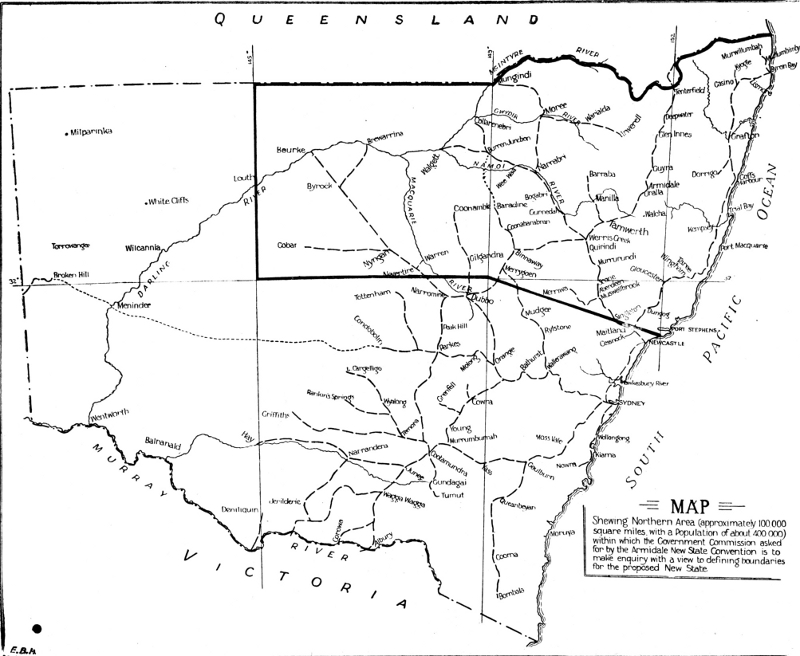
In a comment on History of the New England New State Movement 1 - scope of work, Peter Firminger from Wollombi Valley Online pointed me to a web site that I had forgotten. The site itself has, I think, vanished. Certainly I had not been able to find it. However, it survives in web archive form.
The collapse of the formal movement in the bitter aftermath of the 1967 plebiscite defeat was not quite the end of the story. From time to time in the period since there have been attempts to revive the new state cause. These have taken two forms.
In the first case, there have been calls within specific localities for a New England new state generated by local problems. I dealt with the most recent example in Hunter Valley calls for a Northern NSW New State. These calls have not translated into action because the leadership has not been there to carry it forward, nor has the political climate been right. However, they have kept memory of the concept alive.
In the second case, there have been calls for new states independent of specific local circumstances. These have been partially linked to the idea that we should get rid of new states and replace them with provincial councils. This is actually a very old idea that has bedeviled the entire history of new state movements within Australia. However, beyond this there have also been calls for new states with sovereign powers equivalent to present states.
The web site that Peter found is one of several web sites that emerged during the 1990s and early 2000s promoting the idea of more states within Australia. These sites had a particular linkage to New England because there the movement had been strongest. In arguing as they did, they were within the long tradition of the Northern or New England movement, for this had supported other new state movements for more than fifty years. The broader aim was to create a new Australian Federation made up of a larger number of states based on the concept of geographical community.
As an aside, New England On-line is a fun alternative history site based on the idea of a New England born of rebellion.
Like the local calls for self-government, these web sites failed to ignite interest. They were simply too far outside conventional thinking. The various Australian new state movements themselves had always suffered from this problem, for no political entity nor the people who support it will willingly undergo amputation. The new state movements and especially the New England movement as the separation leader forced attention because they could marshal support.
This did not come about overnight. The linkages and support structures required, the creation of the shared values and ideals necessary to sustain action, were built over time though persistent if sometimes sporadic action. Importantly, they were reinforced and sustained by a shared history.
The reason why more recent attempts to launch a New England or indeed broader movement have failed lies not just in the absence of supporting structures, but in the loss of history after the plebiscite loss. The two generations of political and community leaders who had fought so hard against such impossible odds passed, with few replacements. Their cause was relegated to the historical dust heap, to a few footnotes in histories written by others from a very different perspective.
Against, this background I now want to turn to the changing definitions of New England.
Today the use of the term New England has shrunk in a way that reflects the progressive loss of historical memory, largely shrinking to just the Northern Tablelands. I still use it instead of the alternatives such as the North, Northern NSW or Northern Districts for two reasons.
First, this was the name adopted by the New State Movement for the area seeking self-government and I have used it all my life. Secondly, in writing a history of New England I cannot actually use the term Northern NSW.
The history I am writing is a history of Australia's largest tablelands and its surrounding river valleys. Only after the creation of Queensland and the consequent placement of a political boundary through what had been a geographic entity, does my focus shrink to what is now known as Northern NSW. Obviously the Aboriginal peoples who occupied the Tablelands and its surrounding valleys for millennia did not use the term New England, but I need a label.
The relationship between the area that I call New England and the self-government movement is a sometimes problematical one, for the boundaries of the proposed self-governing area varied over time and did not exactly mirror the territory of what I call New England. To understand this, we need to understand the early history of European settlement, for this set very basic patterns that continue to this day.
Europeans originally came to the North in two broad streams. In the inland, settlement moved from the newly settled areas in the Hunter and Bathurst up through the Western Slopes and the Northern Tablelands and then onto the Northern Rivers and the Moreton Bay district. On the coast, settlement went from river valley to river valley by sea or came down from the newly settled Tablelands areas. By 1850 a pastoral ascendancy had been established with large runs dominated by sheep, with cattle in the rougher country and on parts of the coast. Transport routes mirrored settlement patterns: on the coast shipping was dominant, whereas inland (at least from about Armidale south) the main routes ran overland to the river port at Morpeth in the Hunter. North of Armidale transport went south and also east over the rough escarpment for shipment by sea, largely from Grafton, which was the major river port.
These early transport and settlement patterns created enduring social and economic links. The Hunter Valley, Western Slopes and, to a lesser degree, the Northern Tablelands formed one embryonic unit. This overlapped with a second grouping consisting of the Tablelands and Northern Rivers. South of the Northern Rivers, the coastal zone had progressively less contact and fewer links with either the Tablelands or the Northern Rivers; by Taree the coastal orientation was exclusively south. The coming of the railways during the second half of the century strengthened the north-south axis (the inland grouping) at the expense of the east-west (the Northern Tablelands - Northern Rivers), but otherwise left the basic pattern unchanged.
The growth of farming across New England had little impact on this pattern. The growth of coal mining and manufacturing in the lower Hunter had greater impact. Not only did it lead to Newcastle replacing Maitland as New England's biggest city, but it created an industrial working class that had very different attitudes and needs from those elsewhere in New England.
The patterns have had a profound impact on New England history.
The following graphic from the site Peter found shows the yes voting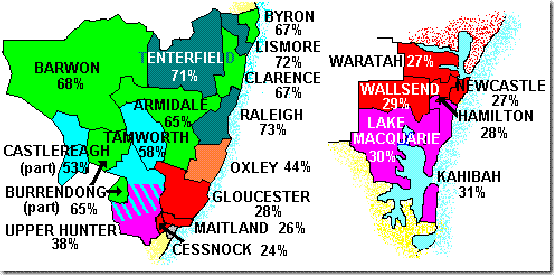 percentages across New England in the 1967 plebiscite based on the state electoral boundaries at the time.
You can clearly see the continued strength of the east-west northern division. For a constitutional referendum, the yes votes in the north are actually huge. This was a popular cause.
Throughout the 19th century and the early part of the twentieth century separatist agitation was centred in the Northern Rivers. The reasons for this were simple. Not only did they feel neglected by the Sydney Government, but the Northern River port towns and especially the rapidly growing Grafton needed better access to their hinterlands. When this was denied, thoughts turned to separation.
The next graphic shows the proposed self-government borders sought by the 1915 Grafton new state agitation. You can clearly see the east-west axis.
This Grafton agitation died, but was replaced by a further and bigger agitation as the First World War ended. This in turn laid the base for a mass newspaper campaign launched on 5 January 1920 by Victor Thompson, the editor of the Tamworth newspaper.
This was no small campaign. By March 1920 up to thirty four - there is some uncertainty on the exact number - of the seventy five or so New England newspapers had expressed support. This led the papers to form a New State Press League and a Press Propaganda Executive to carry the campaign forward.
For present purposes, what is interesting is not the success, but the papers who did not participate. The most southern participating newspaper was in Cessnock, with Hunter Valley support concentrated in the Upper Hunter. The two papers in southern looking and geographically isolated Taree were, to quote Thompson, "quite against the movement." This almost exactly mirrors the pattern of the 1967 no majority vote in the Manning and Lower Hunter.
There is an almost conspiracy theory amongst some New Englanders that Newcastle and the Lower Hunter were included in the 1967 plebiscite boundaries to guarantee a no vote. The reality is a little different,
Newcastle and the Hunter have always been part of New England along the north-south axis. In historical terms, they cannot be excluded. Further, Maitland was the then junction point for the two Northern rail lines. The drawing of a boundary to include Maitland and the Upper Hunter but exclude the Lower Hunter was problematical in the extreme.
There is not space in this post to outline the boundary discussions that took place in 1932 after the defeat of the Lang Government. Prior to the election, the various new state movements had merged with the NSW Country Party to form the United Country Movement. Separatists now occupied key positions in the new Government; for the first time the wholesale break-up of NSW came under active consideration. So far as New England was concerned, the key sticking point was the southern boundary.
On 23 June 1932, the member for Armidale and a senior cabinet minister, David Drummond, wrote to Alderman Parker, the Mayor of Newcastle, saying that he would like to discuss with him the part Newcastle might play in the sub-division movement. He was blunt: Newcastle could play a major role or, alternatively, become part of a Sydney state. Parker took the warning and campaigned for Newcastle's inclusion in New England.
In August 1933, Justice Nicholas was appointed to inquire into the areas of NSW suitable for self-government and in which referenda should be taken to ascertain the wishes of the electorate. He reported in January 1935 setting out proposed boundaries. There were, he concluded, three areas suitable for self-government: a northern area which included Newcastle; a central-west/south west area, and a residue consisting of Sydney, the Blue Mountains and the south coast. He suggested that a referendum should be held in each area, starting with New England.
The New England boundaries themselves reflected river catchments, as well as the need to accommodate the proposed western state. These were the boundaries on which the 1967 plebiscite would be fought.
By the time Nicholas reported, much had changed.
The boundary discussions themselves, including the long-running Nicholas hearings, had sapped the time and energy of key new state activists who, lacking paid staff, had had to organise the entire process on a voluntary basis. The political climate, too, had changed with voting patterns returning to normal as the depression receded. The formation of the United Country Movement itself proved to be something of a poisoned chalice from a new state perspective because it divided opinion.
Nicholas's proposals themselves met with opposition among new staters. Denied their own state, the Riverina Movement rejected them outright. The New England Movement did accept them, although with some misgivings. There were still strong reservations about the inclusion of Newcastle and the Lower Hunter, while the boundaries also excluded areas along the proposed western boundary with strong new state support.
With an election due in May 1935, NSW Premier Stevens declared in the joint-policy speech that the Government would consider whether to proceed with a referendum. In discussions with Mick Bruxner, Deputy Premier and leader of the UCM, Stevens said that Bruxner could have a referendum if he wanted it. Now that the crunch had come, Bruxner rejected the offer for he was fearful that, without a long education campaign, it might be defeated by the Newcastle and coal field votes.
In retrospect, this was a bad decision. A referendum might have been defeated, but it would at least have kept faith with those who had supported the cause over so many years. At worst, a defeat might have set the Movement back a a decade. But by refusing to accept the risk, Bruxner (and the other Northern leaders) achieved this result anyway. Exhausted, the various separatist movements collapsed. It would be more than a decade before the New England Movement would again spring to life.
While the New England Movement had collapsed, it had left some enduring marks. These included a heightened sense of Northern or New England identity, as well as stronger cross-links between individuals and areas. Importantly, the very existence of new state support had provided a political lever for what was described by one writer as functional new statism, organised efforts to gain specific things for New England building on links created. Examples include wool selling at Newcastle and the creation of first the Armidale Teachers College in 1928 and then, ten years later, the New England University College. Both were seen as providing core infrastructure for the future new state.
The New England New State Movement that was now to emerge emerged in a different way and took a very different form from its predecessors.
In 1924, New State supporters had forced the appointment of a NSW Royal Commission, the Cohen Commission, to inquire into the feasibility of new states. They were badly out-manoeuvred in political terms from the beginning, a mistake that they were not to repeat in the formation of the Nicholas Commission. The Royal Commission ruled against new states, arguing instead that the same results could be achieved in a better way through the creation of regional councils within NSW.
Towards the end of the Second World War, there was a resurgence of interest in the need for effective decentralisation. This was part of the overall interest in post-war reconstruction. This led two academics at the New England University College, Drs Belshaw and Voisey, to launch a regional councils movement.
Reflecting the College's origins, from the beginning NEUC staff had seen part of their role in in terms of service to Northern NSW. This was reflected in both research and university extension activities. Both Belshaw as head of economics, Voisey as head of geology had played an active role in these areas.
While Belshaw had married the daughter of long standing New State leader David Drummond, he was not a new stater. Instead, he believed that the best way of achieving decentralisation lay in the creation of effective regional councils along the lines proposed by the Cohen Commission in 1924. In turn, this depended upon state governments being willing to grant real powers to those councils.
The regional councils movement quickly gained support, especially along the traditional east-west axis that had formed the heartland for New State support. Somewhat to Belshaw's chagrin, his regional councils movement turned quite rapidly into a reformed New State Movement.
There were a number of reasons for this. Many of those involved in the new movement had in fact been new staters and were convinced that this remained the best path. Equally importantly, it became clear quite quickly that the NSW Government would never grant the real executive power that the councils needed to be effective. Still not a new state supporter but now convinced that regional councils could not work, Belshaw turned to other ways of achieving decentralisation, developing the concept of selective or focused decentralisation that would late form the basis of the Whitlam Government growth centres policy.
The new New England New State Movement differed from its immediate predecessor in two important respects. While still heavily dominated by Country Party supporters, it was strictly non-party political. While previous leaders such as Bruxner or Drummond were still important, formal leadership now lay outside the parliamentarians.
The second difference lay in the appointment of staff. This made the Movement's continuance less dependant upon volunteers and fluctuating popular support. In 1961 the Movement launched Operation Seventh State, a major campaign that would, six years later, result in the plebiscite.
Despite some continued opposition, the Movement campaigned on the Nicholas boundaries because these were defined, had official status and had previously been accepted by the Movement. However, that left open the same type of problem that had worried Bruxner all those years before. Could Newcastle and the Lower Hunter be persuaded to vote yes.
The early signs were not encouraging. In 1963, four years before the plebiscite, Eric Woolmington carried out a detailed analysis of the pattern of geographic support for the Movement using a variety of indicators. This showed that support for separation continued to mirror traditional patterns. Woolmington's conclusions predicted the 1967 vote almost exactly.
The problem faced by the Movement can be very simply put. Newcastle people saw themselves as part of the North. In response to the question if there is to be a New England New State should Newcastle be part, a clear majority said yes. However, when asked a follow up question along the lines the ALP is opposed to New States, would you vote yes in a referendum, an overwhelming no vote emerged that almost exactly mirrored the traditional ALP vote in these blue ribbon seats. Party affiliations overrode the sense of geographical consciousness.
 Following the 1967 defeat, and as shown in the attached graphic from the web site Peter found, the Movement regrouped by re-drawing the proposed boundaries in 1968. The main no vote areas were excluded, with some traditional support areas to the west added.
There was one more bitter twist to come. With the plebiscite lost, the Movement decided to run independent candidates at the State elections in electorates with strong new state support. These were also electorates held by the Country Party, the Movement's traditional Party supporter.
Furious at what they saw as betrayal, the Country Party leadership responded by effectively proscribing the Movement, a split that carried through into quite bitter disputes at local level. With its support base now split, the Movement failed to gain any seats and finally collapsed. The Country Party itself was badly damaged, although it would take some time before this became clear.
While I have necessarily provided a potted history of the New State Movement in this post, my primary concern has been to outline some of the issues involved in defining New England. I now want to finish by looking a little a little at what has happened to the idea of New England or the North in the forty three years since the plebiscite defeat.
I mentioned Eric the geographer Eric Woolmington earlier. Woolmington was not a New State supporter. However, in a discussion in Armidale just before the 1967 vote Woolmington said very bluntly that anyone who voted no was a bloody idiot. His argument was that, regardless of whether or not New England could gain self-government, the existence of the New State Movement and the campaign for self-government was the single biggest political weapon that New England had in ensuring that regional needs were addressed. Sadly, he was right.
At one level New England does continue simply because it is in fact a natural geographic entity. You can see this if you overlap the various administrative divisions currently used by the NSW Government with the Nicholas boundaries. The phrase the North is still used to cover the broader area. Beyond that, the sense of broader identity has certainly declined, as have the cross-area linkages. Perhaps most importantly, the visibility of the broader area has also declined in sometimes unseen ways.
Starting with the use of the word New England itself: in 1967 my use of the term New England to describe the broader area would have been clearly understood; today I have to explain it. In common usage, the term has shrunk to the area now known as the New England North West. There have been other small but subtle language shifts as well.
ABC radio now frequently calls Armidale a North-Western town. Grafton is often described as being on the Mid-North Coast. Newcastle is sometimes described as part of Greater Sydney.
One of the biggest changes that has occurred has been the rapid population growth on the North Coast from the 1980s. While some of this has come from internal New England migration, a significant proportion has also come from outside New England. Given the cessation of the active new state campaigning that used to reinforce the sense of the North, of being different, my impression is (I could not be certain without polling) that many have limited interest in or understanding of the broader sense of regional identity.
In political terms, it is the Nationals who have suffered most from the diminished sense of regional identity. New England was Country Party heartland. The Party could identify with, gain from and promote the separate sense of Northern identity. Now the Party is squeezed between a rise in the Labor vote especially in the Northern Rivers and the independents.
I find it interesting that independent territory runs along the east-west axis that has provide the heart of New State support. It's not exact, other changes have intervened, but it is still quite a close correlation.