Discussions on the history and historiography of Australia's New England

Showing posts with label New England geography. Show all posts

Monday, December 18, 2017

Understanding the impact of sea level change in Aboriginal New England - a second note

This note briefly follows up on some of the issues I mentioned in Understanding the impact of sea level change in Aboriginal New England - a note.

Storegga Slides

In a comment on the post, JohnB referenced the three Storegga Slides, considered to be among the largest known landslides. Wikipedia states that they occurred under water, at the edge of Norway's continental shelf in the Norwegian Sea, approximately 6225–6170 BCE. The collapse involved an estimated 290 km (180 mi) length of coastal shelf, with a total volume of 3,500 km3 (840 cu mi) of debris, which caused a very large tsunami in the North Atlantic Ocean. In Scotland, traces of the tsunami associated with the last slide have been found, with deposited sediment being discovered in Montrose Basin, the Firth of Forth, up to 80 km (50 mi) inland and 4 m (13 ft) above current normal tide levels.

The Australian slides referred to in my note appear smaller, with the biggest one described as "several tens of kilometres across."  That would still have had a significant if more localised effect.

Climate Change and the Making of Britain. 

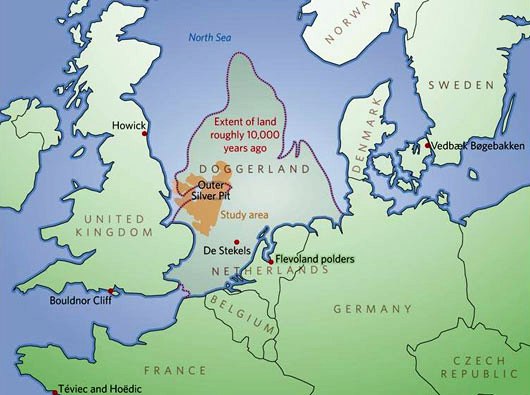
The last Storegga slide may have marked the final end of Doggerland (and here), the landbridge connecting England and the European mainland.

An brief article by Tate Greenhalgh and Lisa Hendry (The making of an island, Natural History Museum, 15 December 2017)  traces the interaction between climate, sea levels and Hominin occupation of what are now the British Isles over 950,000 years.

It's very simplified, but it is easy to read and provides an overview of the scale of change.

Post-glacial Sea Level Change in Australia

Following my earlier post, I found a very good review article, Lewis, S.E., et al., "Post-glacial sea-level changes around the Australian margin: a review", Quaternary Science Reviews (2012), http://dx.doi.org/10.1016/j.quascirev.2012.09.006.

It's a very interesting article because of the way it consolidates the current state of the research on the pattern of sea level change and the reasons for  local variations over the period from the lowstand during the Last Glacial Maximum through to the Holocene highstand and then the relatively slight fall to the standstill sea level around the present level. It fills another gap in my research.

JohnB wondered if memories of landslip induced tsunamis might be found in Aboriginal oral history. I don't know. However, in an earlier article in The Conversation ( Ancient Aboriginal stories preserve history of a rise in sea level, January 13,  2015) by Nick Reid  and Patrick D. Nunn concludes that the memory of the impact of the sea rise was preserved in Aboriginal oral tradition.  

Monday, December 11, 2017

Understanding the impact of sea level change in Aboriginal New England - a note


Underwater landslip on the downward slope of the continental shelf off Byron Bay. New research shows a large number of such slips, many of which have occurred in the last 25,000 years. These were within the period of Aboriginal occupation of New England, a time of great changes in sea levels.    

Interesting article in The Conversation (11 December 2017) by Samantha Clarke, Hannah Power, Kaya Wilson and Tom Hubble, Scars left by Australia’s undersea landslides reveal future tsunami potential on evidence for sometimes large underwater landslides on the downward slope where the continental shelf  falls away to deeper water. This diagram from the article illustrates the process.


The focus in the article is on tsunami risk from future landslips. However, I was interested both in the undersea pictures and the reference to frequency over the last 25,000 year for this was a period of substantial sea level change.

Pattern of Sea Level Change

Without bogging down in dates,  the last ice age began about 110,000 years ago. Sea levels fluctuated, falling during glacial periods, rising during warmer interglacial periods. Around 40,000 years ago, sea levels were perhaps 50 metres below present levels. From around 36,000 years ago, the climate became cooler and drier. Then from around 25,000 years ago the climate deteriorated very significantly with spreading ice sheets globally. This climatic regime peaked during what is called the Last Glacial Maximum (LGM), 21,000 to 15,000 years ago.

As more water turned to ice, sea levels fell significantly, bottoming around 18,000 years ago at perhaps 120-130 metres below present levels. At this height, parts of the continental shelf slope break line could have been 20-30 metres above water.

The LGM began to ease around 15,000 years ago. The North American ice sheets melted. Around 12,000 years ago, the Antarctic ice sheets began to shrink. The Holocene with its higher rainfall and warmer temperatures had begun. The seas rose and rose again, reaching present levels around 6,000 years ago, a total sea level rise of 120-130 metres over 9,000 years.  .

The erosive effects as the sea rose onto and then submerged the continental shelf must have been very considerable. I wondered what the connection might be between the number of identified slips and this sea level rise. Whether triggered by earth movements or erosion, the bigger slips could have had significant localised impacts.

Discussion

My own research focuses on the broader New England. At the moment, my best estimate is that the Aborigines reached the area perhaps 31-32,000 years ago. We do not have hard evidence for this, but the time is consistent with the pattern of dates that we do have. This means that the climatic and sea level changes described above are of considerable importance. However, we need to understand the local pattern of change if we are draw tentative conclusions about their impact on Aboriginal life. The absence of relevant local material has been a considerable frustration.

The Clarke et al article provides another little building block. In checking the latest material, I also found a 2010 paper that I had not seen before: Alan Jordan, Peter Davies, Tim Ingleton, Edwina Foulsham, Joe Neilson and Tim Pritchard,  Seabed habitat mapping of the continental shelf of NSW, Department of Environment, Climate Change and Water NSW, Sydney 2010. This focuses on the current seabed habitat along the NSW, but it contains some of the best local descriptions that I have seen of the shape of the continental shelf.

I have not had time to absorb this properly. I am referencing it here as a record for later study.


Tuesday, February 14, 2012

Why do New England's rivers often flow south-north?

In my last post, Did New England have glaciers?, I referred to  evidence provided by Road suggesting that Pleistocene New England may have been colder than we realised. This led me to follow up in my Armidale Express column, Belshaw's World - no wonder it’s cold here.

Now Rod has a new post, The backward Clarence River, looking at the puzzle set by the direction of New England's river flows. Rod is focusing on the Clarence, but the same pattern holds inland.

Simply put, many New England rivers that you would think should flow east-west or west-east actually flow north or sometimes south. They get to the sea or Darling River, but not in the way you might expect. This results in a pattern that somehow seems at odds with the current landscape.

The answer has to lie in the pattern of past geological change, although our understanding of this is still very imperfect.   

Monday, January 30, 2012

Did New England have glaciers?

Back in October, one of the points in Aboriginal New England in the Pleistocene Period I spoke of the impact on any then Aboriginal settlement of the long cold period that began around 25,000 years ago. There I said in part:

The Tablelands would have been a very different story. Here average temperatures fell by perhaps 8 degrees C. The New England Tablelands marked the start of a region of cold steppe and scattered sub-alpine woodland sweeping down through the southern Snowy Mountains into Tasmania.

In the southern Snowy Mountains, the fall in temperature was sufficient to allow glaciers to form despite the lower precipitation. In New England, the higher portions of the Tablelands in the centre and south where average heights are around 1,300 metres must have been very cold, dry and windswept. Along New England’s Snowy Mountains where the highest peak (Round Mountain) is almost 1,600 metres, there were probably blizzards and semi-permanent snow despite the much lower precipitation.

Now in an interesting post, How cold was it? Glaciers in New England?, Rod has suggested based on a comment from Bob H that New England may actually display cold climate glacial features. If so, it was colder than we realised, something that might help explain the apparent absence to this point of Aboriginal settlement.  

Sunday, October 30, 2011

Aboriginal New England in the Pleistocene Period

Introduction

A very long time ago, on 4 February 2007 to be precise, The Macleay Valley - the glacial age, provided an initial introduction to the paleogeography of New England. Since then, I have done bits and pieces, but still do not have a clear picture firmly fixed in my mind.

In October this year, Rod began his blog on Northern Rivers Geology. I asked Rod whether he would write something on change over the last 50,000 years. He has promised to do so in due course.

50,000 years is an important span from my perspective because it presently represents the maximum period of Aboriginal occupation of New England. The earliest accepted date we presently have for a location just to the north of New England is some 20,000 years ago. My feeling is that occupation probably began earlier. 

History is about dialogue, dialogue with our sources, dialogue with those interested. To encourage Rod and to extend dialogue, I have decided to post some of my own notes on New England's paleogeography as my contribution to discussion.

Aboriginal New England in the Pleistocene Period

Aboriginal people may have reached the area that would be variously called Northern New South Wales, the North, Northern Districts or New England as early as 40,000 years ago.

We know from dating at Warren Cave in Tasmania that the Aborigines had reached Tasmania around 35,000 years ago[1] while dates from Willandra Lakes in South West New South Wales suggest occupation as early as 41-40,000 years ago[2]. Given these dates, it seems reasonable to assume a working date of around 40,000 years ago for first Aboriginal occupation of New England.

We do not have hard evidence for this dates. The earliest confirmed date I know of in New England itself comes from a dig by Graham Connor at Stuarts Point in the Macleay Valley. This places human occupation at 9,320 +/- 160BP[3]. Further north in South-East Queensland, the Wallen Wallen Creek site shows continuous occupation from about 20,000 years ago.[4]

The Cuddie Springs site near Brewarrina is especially interesting because it suggests occupation as long ago as 35,000 years BP.[5] However, dates here have been subject to considerable dispute and there presently appears to be no agreement on the issue.[6]

Despite the absence of earlier dates, it is hard to believe that the Aborigines had not reached New England if they were at Willandra Lakes around 40,000 years ago, had reached the southwest of what is now Tasmania by at least 35,000 years ago.

What type of world did they find?

Sea levels fluctuated greatly during the long Pleistocene period. Forty thousand years ago, sea levels were perhaps 50 metres below current levels, creating a broader coastal plain. Rainfall was high, temperatures moderate. Rivers running east and west from the Tablelands would have carried substantial volumes of water.

In the east, the river estuaries and wetlands as we know them today did not exist, nor did bays and harbours such as Trial Bay or Port Stephens[7]. The present sea bed drops reasonably sharply in spots, so there would probably have been a significant gradient towards the sea with current headlands standing out as hills or ridges.

The significant volumes of water carried in the eastern flowing streams would have led to some progradation pushing the land out into the sea. With time, this would have led to river estuaries, coastal dunes and marshes. It seems likely that the larger coastal strip was thickly wooded and reasonably rich in marine and land resources.

In the west, the rivers and associated wet lands would also have provided a rich environment., although probably not as rich as it was to become.

The position on the Tablelands is unclear because so much of the analysis that I have seen deals with later periods. I suspect that the Tablelands were wooded and at least visited by surrounding groups.

The size and distribution of the early Aboriginal population is obviously unknown since at this stage we have yet to prove that they even existed. My own feeling is that it was probably much smaller but mirrored the pattern at the time the Europeans arrived; higher concentrations on the coast and on the western slopes and immediate plains, sparse on the Tablelands.

From around 36,000 years ago, the climate became cooler and drier. The cooler temperatures offset the lower rainfall by reduced evaporation; the streams, lakes and wetlands of inland New England therefore retained their water, providing a continued base for Aboriginal occupation.

From perhaps 25,000 years ago, the local environment deteriorated significantly. Sahul, the name given to the continent that then included Australia and New Guinea, became very dry, both intensely hot and intensely cold. This climatic regime peaked during what is called the Last Glacial Maximum, 21,000 to 15,000 years ago.

The sea retreated to perhaps 120 metres below current levels. The sea became colder, 2-4 degrees C below current levels. On land, mean monthly temperatures probably fell by 6-10 degrees C. Extensive inland dune building suggests that the climate become much windier.

According to Mulvaney and Kamminga, severe cold, drought, and strong winds over central and southern Sahul, would have discouraged tree growth , although some species common today must have survived in sheltered or better-watered refuges.[8]

The retreating sea would have progressively increased the size of New England’s coastal strip. The impact here would have varied along the coast, depending upon water depth. In broad terms, the immediately adjacent shallow water to the east of the present coast is quite narrow, with the continental shelf then falling away sharply.

In South East Queensland to the north, the falling waters probably extended the coastal strip to between twelve and twenty kilometres east from what is now Stradbroke Island.[9] Further south the lower water zone narrows, before widening a little after what is now Nambucca. In the case of what is now the Macleay Valley, the coast line probably extended ten to sixteen kilometres to the east.[10]

The sclerophyll woodland and deciduous forests would have progressively colonised the new land, with the coastal dunes and associated wetlands following the shifting coast east.

The Tablelands would have been a very different story. Here average temperatures fell by perhaps 8 degrees C. The New England Tablelands marked the start of a region of cold steppe and scattered sub-alpine woodland sweeping down through the southern Snowy Mountains[11] into Tasmania.

In the southern Snowy Mountains, the fall in temperature was sufficient to allow glaciers to form despite the lower precipitation. In New England, the higher portions of the Tablelands in the centre and south where average heights are around 1,300 metres must have been very cold, dry and windswept. Along New England’s Snowy Mountains where the highest peak (Round Mountain) is almost 1,600 metres, there were probably blizzards and semi-permanent snow despite the much lower precipitation.

To the west, Mulvaney and Kamminga suggest that much of the south-eastern interior of Sahul experienced cold arid conditions similar to modern Patagonia[12].

Josphine Flood notes that the pollen record for Cuddie Springs on the Western Plains shows decreasing tree, shrub and grass cover with a rise in saltbush (Chenopodiaceae) suggesting growing aridity as the as the glacial maximum approached[13]. She suggests that the environmental record for Ulunga Springs, 180 kilometres southeast of Cuddie Springs, shows a similar pattern between 30,000 to 10,000 BP. The net effect was an expansion of the continent’s arid core by at least 150 kilometres.

That said, the lower western Tablelands and slopes were probably vegetated by grassland with spring herbs with patches of woodland and forests. Further west, the streams crossed the arid plains.

While these changes took millennia and would not have been noticeable to individual generations, the effect on the human population must have been quite severe.

Water and food supply were two of the critical determinants of prehistoric demography. Water became scarcer, droughts more frequent. Food supply was reduced. Over time, populations would have been forced to relocate and may well have become much smaller.

In the absence of archaeological evidence, it is impossible to say just what the precise effects were in New England. While colder and drier, there would have been sufficient water and food resources to maintain populations

We know that there was Aboriginal occupation of the coastal strip given that the Wallen Wallen site in South East Queensland shows continuous occupation from 20,000 years ago, a date in the earlier part the Late Glacial Maximum. It is reasonable to assume that any occupation on at least the majority of the Tablelands ceased. But what happened further west?

Under current climate, Northern NSW is generally wetter and warmer than Southern NSW because the area is affected by two different weather patterns. Rainfall also declines to the west because of the impact of the Eastern Ranges.

The climate during the Late Glacial Maximum was clearly very different. However, my feeling is that the current pattern was replicated to some extent because of air flows from what is now the Pacific.

In later times, ethno-historical evidence suggests that the presence of standing water was very important[14]. During wet periods, people moved out into the broader landscape, concentrating round permanent water during dry periods.

With diminished rainfall but also lower temperatures, it seems likely that there were areas on the Western Slopes and Plains that would have continued to provide sufficient water and food to maintain life. Why, then, is there still no archaeological record? It seems likely that any previous human occupation of the Tablelands would have come to an end, although people may still have visited the lower areas.

Assuming that the area was populated, the pattern of sites would have reflected then on-ground conditions. Many of the sites would have been camping sites, not easily identifiable beyond lithic scatter. Other sites would have reflected the then location of permanent water.

My feeling is that we need to chart what the landscape was like then to identify possible sites. Mind you, this may already have been done and I have simply not discovered the analysis.


[1] John Mulvaney & Johan Kamminga, Prehistory of Australia, Allen & Unwin, Crows Nest, 1999. P186. The broad framework for this section is drawn especially from Mulvaney & Kamminga’s work.

[2] Munvaney & Kamminga, op cit, p197. There is debate about the Wilandra Lakes dates, with some arguing for older dates. Josephine Flood, Archaeology of the Dreamtime, J.B. Publishing, Marleston, revised edition, 2004, p1.

[3] G Connah, Archaeology at the University of New England 1975-76, Australian Archaeology, No 5, 1976, PP1-5.

[4] Ian Walters, Antiquity of Marine Fishing in South-East Queensland, QAR, Vol 9, 1992, pp35-39. P35. Accessed on line 4 April 2009.

[5] Josephine Flood, Archaeology of the Dreamtime, J.B. Publishing, Marleston, revised edition, 2004, p189.

[6] The Wikipedia article, Cuddie Springs, provides an interesting discussion on this issue. Accessed 15 April 2009.

[7] The analysis here is based on an assessment of the present coastal boating maps accessed 15 April 2009. A full assessment would require analysis of broader maps indicating varying depths of the sea bottom, allowing a better assessment to be made of the outer coastal strip..

[8] Mulvaney & Kamminga, op cit, p116

[9] Flood, op cit, p113

[10]

[11] I have used the term southern Snowy Mountains because New England has its own smaller range also called the Snowy Mountains.

[12] Mulvaney & Kamminga, op cit, p117

[13] Flood, op cit, p192. .

[14] J Belshaw Population distribution and the pattern of seasonal movement in northern New South Wales. In I. McBryde (ed.), Records of Times Past, pp.65-81. Canberra: Australian Institute of Aboriginal Studies, 1978


Saturday, January 15, 2011

Environment and the distribution of Aboriginal languages in NSW

In a post on my personal bog, Why micro-environments are important, I discussed the importance of micro-environments. That post was triggered by my re-reading of the commentaries associated with the 1977 Atlas of New England published by the University of New England Geography Department[1]. In that post I referred to the Kamilaroi (Gamilaraay) language group. This drew the following comment from David Nash from the Australian National University’s Linguistics Department:

"The large Kamilaroi language group is large because it had access to water ..."

I don't think this follows (whether you mean large in territory or in population). Compare the size of language groups along other large rivers. Or one could equally suppose that assured water could be shared by many different groups each of whom need less territory.

David’s comment was helpful because it highlighted an area where my thinking was arguably sloppy. For that reason, I decided to take the opportunity offered by David’s comment to clarify and extend my thinking. The material that follows should be read as musings, thoughts in progress.

Introducing Geography and the Distribution of Aboriginal Languages

In their Prehistory of Australia, Mulvaney and Kamminga noted that there have been numerous attempts to map complexes of Aboriginal cultural traits throughout the continent that might help understanding of the major differences in language, social customs, mythology, artistic styles and technology.[2]. To their mind, the 1976 explanation by Nicholas Petersen was the most persuasive.

Petersen observed that major cultural areas correspond with major drainage basins. He suggested that the reason for this is that the topography and environments of drainage basins tend to be internally uniform, while their margins are relatively poor in plant, animal and water resources. This led to more social interaction between groups living within the basin; much less between groups living on either side of the marginal zones.

Petersen’s conclusions broadly fit with those that I reached in my own earlier work[3]. However, I also considered that major geographic regions were important since the close relationship between the Aborigines and their environment meant that the patterns of Aboriginal life varied with changes to that environment. By implication, areas with similar environments were more likely to have commonalities in life and culture.

To the degree that this conclusion is correct, we would expect similarities within New England’s major north-south zones, the humid coastal strip, tablelands, western slopes and western plains. Indeed, this does seem to have been the case.

So at this level, we seem to have a clear if sometimes uncertain relationship between geography and language distribution linked to river catchments, as well as other major geographic features. We can extend this analysis by looking at the distribution of Aboriginal languages across NSW as a whole.

Distribution of Aboriginal Languages

The following map shows the distribution of Aboriginal languages across NSW as defined in The Encyclopaedia of Aboriginal Australia[4]. There are a number of problems with the map in terms of names and boundaries, problems that I discussed in my 2010 paper delivered to a meeting of the Armidale & District Historical Society[5]. We can ignore these for the present because we are interested in broad patterns.

Look at the map first: my comments follow afterwards.

clip_image002

If you look first at the bottom of the map, you will see a heavy concentration of languages. These follow the Murray River, a rich and densely populated Aboriginal area at the time of European colonisation. Much of the land along the Murray is semi-arid. Aboriginal populations concentrated on the river, living a semi-sedentary life[6]. Here language territories effectively subdivide the riverine corridor.

On the left of the map, there are a range of languages - a patchwork quilt - occupying larger territories. These are the languages of the Darling River and western deserts. Like the Murray, the Darling was quite densely populated, although densities were far less. The Darling is simply a smaller river. As with the Murray, languages ran along the river, but the relationship between river and language distribution is more complex, less certain. The variety in the desert languages to the west of the Darling is a factor of distance and small populations; languages and dialects diverged because of distance.

To the right of the Darling, we find the two biggest language groups by area, the Wiradjuri and and the somewhat smaller Kamilaroi. They occupied the river valleys flowing to the west from the Great Diving Range. These were quite rich territories; language expansion was facilitated by geography, people could spread. Here another pattern seems to emerge.

These language groups occupy multiple river valleys. However, Michael O’Rourke’s study of the Kamilaroi[7] suggests that social and to a degree language or dialect groupings still ran along rivers; language dividing lines could cross catchments

The broad sweep of languages along the Western Slopes and Plains, the riverine languages, seem clearly related, merging into the languages of the western deserts. Dividing lines are linked to rivers and catchments. However the relationship is not an exact one.

Along the coast and adjoining ranges you have another dense distribution. On the coast, there is a clearer relationship between catchment areas and language distributions. We can think of this in both north-south and east-west terms.

North-south, most language groups are directly related to catchments. The partial exception is the Clarence, the big river. There the sheer size of the river made it the divide between two very different language groups, the Gumbaynggirr and the Bandjalung. A third Gumbaynggirr related language, Yaygirr, occupied the areas around the mouth of the Clarence.

East-west, there appear to be language shadings inland. In the Hunter Valley, for example, the traditional presentation of language distribution has a coastal language with a linked inland language. The position further north appears somewhat similar. Bainbaa, the language spoken in the headwaters of the Nymboida River (a tributary of the Clarence to the south extending into the Tablelands near Guyra) appears to be a version of Gumbaynggirr.

Tribal groups occupying the Tablelands areas between the Kamilaroi/Wiradjuri and the coastal languages were generally smaller in population because the environment was poorer. They were also squeezed. The New England Tablelands, the largest tablelands in Australia, is shown with just two language groups

If we now drill down, we can see more of the relationships between geography and the distribution of people. The nature of the evidence means that our analysis must be uncertain. Still, patterns do seem to emerge.

Geography and the Distribution of People

Traditional Aboriginal life was organised around family groups linked in a variety of ways with other family groups. Each family group occupied a particular territory or run. Groups gathered together for particular purposes, ceremonial or to take advantage of periodic food surpluses. There seems to have been a fair bit of what we would now think of as travel, longer journeys by individuals or small numbers for particular purposes including adventure or warfare. There were also traditional patterns of friendship or enmity.

Relationships within and between groups were governed by a complex web of culture and tradition. While boundaries existed, they were not defined in the way we think of them today, hard lines on a map. Rather, boundaries are better thought of as a series of overlapping patterns divided by shaded lines.

Boundaries shifted with time. Over time, the smallest unit, the extended family group, was vulnerable; warfare or changing local conditions could see their effective disappearance. We can see some of these forces in play in the stories associated with the Gunnedah Kamilaroi leader the Red Kangaroo, one of the few Aboriginal tales to have survived presenting a picture of the dynamics of Aboriginal life in New England in the pre-colonial era[8]. Here we have a picture of internal group dynamics, of concerns about survival in a sometimes hostile environment, of warfare.

By their nature, the larger language groups were more stable in geographic terms than smaller units, although here too it seems likely that boundaries shifted with time. The language groups were not political entities, rather groups that appear to speak common or at least related dialects.

Each of the larger language groups covered a number of dialects, with the number determined by a combination of geographic coverage and population size. The Anaiwan or Nganyaywana Aboriginal peoples who occupied the southern areas of the New England Tablelands appear to have been relatively homogeneous and limited in number, although even here there is debate about the number of dialects. By contrast, the Bundjalung language group occupying territory stretching from the Clarence Valley into Southern Queensland may have had as many as twenty separate dialects[9]. To the west, the Kamilaroi may have had at least five major dialects, seven if the related languages of Yuwaalaraay and Yuwaaliyaay are included[10]. Bigambul, the language group on the slopes and plains in Queensland to the north was also reported to be close to Gamilaraay[11].

My point in this discussion is that when we talk about geography and the distribution of people we are in fact talking about a complex hierarchy that moves up from the family group to the much larger language group.

The Aborigines and the Importance of Water

Australia is a very dry continent, marked by periodic droughts and floods. The inland rivers of the Murray- Darling Basin including the Murray have all stopped flowing for periods in recorded times. This affects not just water for human consumption, but also the vegetable and animal food supplies on which the Aborigines depended.

It seems that the size and distribution of Aboriginal populations were broadly related to what we might think of as the carrying capacity of the country in bad times. However, this relationship was a variable one. Among other things, the human birth rate cannot be exactly matched to changing conditions. It seems likely that populations expanded during prolonged good times, then contracted.

We have some evidence for this from the Murray River with its high population but smaller river dependent language territories. There skeletal evidence from burials shows signs of periodic malnutrition.

Elsewhere in inland NSW, Aboriginal populations concentrated near water during dry periods, expanding across land at other times to take advantage of newly available water and food resources. Here we need to distinguish between local groups and larger entities.

Looking at it from a language group perspective, as compared especially to the Murray language groups, both the Kamilaroi and Wiradjuri occupied large and varied territories running along the rivers from the Western Slopes out onto the Western Plains. This provided a variety of natural resources. During dry periods, population shifted within language group territories, although there may also gave been shifts at the margin between language groups recognising the shading of boundaries and the complexity of social relationships.

Looking at it from a small group perspective, the size of runs varied depending on the area required to support the group. Putting this another way, the population density varied greatly depending on the geography. Here O’Rourke quotes various estimated population densities for different parts of Australia ranging from 1.3 square kilometres per person on the tropical coast, north east Arnhem Land to 200 square kilometres per person in arid central Australia[12].

All these estimates are speculative. However, they illustrate the point that similar size groups required different size runs depending on geographic location. Even then, local groups were more vulnerable to extreme conditions than larger groups.

From a language group perspective, the size of language groups was a function of area covered times population density. Some had only a few hundred speakers, others more than 10,000. O’Rourke’s guestimate of 10,000 for the pre-contact Kamilaroi population is probably not unreasonable, making them a large language group. By contrast, the Aboriginal language groups on the Northern Tablelands had far smaller populations, perhaps in the hundreds or low thousands, reflecting smaller territories as well as availability of natural resources.

I have focused so far on the inland population. The coastal population including the large North Coast language groups had access to extremely rich environments combining land, riverine and the immediate estuarine and coastal strip itself. Like the Murray, some groups were semi-sedentary. My own original guestimate was that coastal population densities were perhaps twice that of the territory occupied by the Kamilaroi, although there were variations on the coast too, with lower densities in the upper river valleys as compared to the immediate coastal strip.

The Importance of Micro-environments

The close relationship between immediate local environments and Aboriginal life including the size and distribution of the Aboriginal population is the reason why an understanding of micro-environments is so important in increasing our understanding of Aboriginal life.

On the Northern Tablelands, for example, there appears to be a relationship between population distribution and soil types, for better soils provided a wider range of vegetable products as well as certain animal life. On the Liverpool Plains, ground water that fed springs probably played some role in maintaining what appears to have been a higher density population because it provided a better water supply in dry times.

I have only begun to scratch the surface here in terms of my own understanding of the relationships between such variations and Aboriginal life, including the way in which Aboriginal responses affected the environment. An example is the way in which burning appears to have maintained the Liverpool Plains as a more open environment, increasing the supply of animal and vegetable foods.

All very interesting, at least to me!


[1] David A. M. Lea, John J. J. Pigram, Lesley Greenwood (eds), An Atlas of New England, Volume 2, The Commentaries, University of New England Geography Department, Armidale, 1977

[2] John Mulvaney & Johan Kamminga, Prehistory of Australia, Allen & Unwin, Crows Nest, 1999, p78

[3] J. Belshaw, The Economic Base of Aboriginal Life in Northern NSW in the Nineteenth Century, BA (Hons) thesis, UNE, 1966; Population distribution and the pattern of seasonal movement in northern NSW, in Isabel McBryde (ed), Records of Times Past: Ethno-historical Essays on the Culture of the New England Tribes, AITSIS, Canberra, 1978

[4] Horton, David, general editor The Encyclopaedia of Aboriginal Australia : Aboriginal and Torres Strait Islander history, society and culture, Aboriginal Studies Press for the Australian Institute of Aboriginal and Torres Strait Islander Studies, Canberra : 1994.. The map itself is drawn from the NSW Aboriginal Housing Office web site accessed 6 October 2009.

[5] Jim Belshaw, An Exploration of New England’s Aboriginal Languages, Paper delivered to a meeting of the Armidale & District Historical Society, Armidale 20 July 2010. In revision for publication.

[6] Material on Aboriginal life along the Murray is drawn from Mulvaney & Kamminga, 1999, especially pp 302-309

[7] Michael O’Rourke, The Kamilaroi Lands,: North-Central New South Wales in the Early 19th Century, published by the author, Griffith, 1997

[8] Michael O’Rourke, “Sung for Generations” Tales of Red Kangaroo War-Leader of Gunnedah. The Ewing Manuscripts transcribed with a commentary, published by the author, Braddon, 2005.

[9] Muurrbay Aboriginal Language and Culture Co-operative, Bundjalung, http://www.muurrbay.org.au/bundjalung.html, accessed on line 19 August 2009.

[10] The material on the Gamillaraay is drawn from Peter K Austin, The Gamilaraay (Kamilaroi) Language, northern New South Wales — A Brief History of Research, SOAS, University of London, 2006, accessed on-line 17 December 2008.

[11] Flick Isabel & Heather Goodall, Isabel Flick: the many lives of an extraordinary woman, Allen & Unwin, Crows Nest, 2004, p3.

[12] O’Rourke, 1977, pp139-141
Tuesday, August 17, 2010

Aboriginal populations and sea level change

I have really been bogged down looking at the distribution of New England's Aboriginal languages. I want to get the paper that I gave in Armidale to July to the point that I can post it here for comment, but I keep finding things that I don't know. Indeed, some (much?) may be unknowable.

I talked a little about the problems I faced in a post on my personal blog, McBryde, Hoddinott and the story of New England's Aboriginal peoples. I really want to tell a story in a way that does credit to my subject matter.

After completing that post, I completed my re-reading of some of Isabel McBryde's work that I referred to in that post. In turn, this triggered another stream of thought, something that I referred to in one of today's posts, Gold, geography and the patterns of Aboriginal life.

I have often written of the importance of geography to the history of New England. Yet the more I research, the less I realise that I know.

In this morning's post, I talked about the conundrum posed by the apparently late dates for Aboriginal settlement in New England. I ended by wondering whether this was due to the nature of the sites or to a combination of geography with climate change.

In this post I want to flesh this out a little. I am not trying to make the argument rigorous; this is simply a muse.

When I look at the pattern of traditional Aboriginal life on the North Coast, certain things stand out.

The first thing is a whole series of micro-environments. The Aborigines used these in a variety of ways giving different groups access. This led to a pattern of seasonal change designed in part not to exhaust the resources available in particular environments. So the shell fish usage suggested by the middens along the northern bank of the Clarence near the mouth and as tested by the dig at Wombah indicates that usage was sporadic, seasonal.

We also know that the richness of environments varied between environments, as well as in seasonal terms within environments. The carrying population was related not to the maximum carrying capacity of an environment, but to the carrying capacity of the environment over time. Various techniques were used to control population.

If you start from the premise of different micro-environments offering different resource bases, then it seems reasonable to ask the question how those micro-environments may have changed over time and how this might have affected populations.

We know, I think, that the greatest food resources were to be found along the immediate coastal strip and in the rivers and swamps immediately behind. This area combined a variety of aquatic and vegetable food resources, along with some animal and bird resources. This was also an area where life seems to have been somewhat more sedentary, population numbers higher.

Okay, so far so good. Now when I look at the impact of changes in sea levels, it seems to me that their effects would have been greatest along the immediate coastal strips and the swamps and estuaries behind, the areas of highest food value. As seas rose or fell, the calorie value would have been immediately affected. Further, it would have taken time for the food position to stabilise.

If this is the case, and if we look at the patterns of sea level changes, it might suggest that that the great richness to be found in the immediate past was in fact quite recent in historical terms. If that were the case, then it would explain dating patterns.

Sunday, April 05, 2009

New England in the Pleistocene Period

Aboriginal people may have reached the area that would be variously called Northern New South Wales, the North, Northern Districts or New England as early as 40,000 years ago.

We know from dating at Warren Cave in Tasmania that the Aborigines had reached Tasmania around 35,000 years ago[1], while dates from Willandra Lakes in South West New South Wales suggest occupation as early as 41-40,000 years ago[2]. Given these dates, it seems reasonable to assume a working date of around 40,000 years ago for first Aboriginal occupation of New England.

We do not have hard evidence for these dates. The earliest date I know of in New England itself comes from a dig by Graham Connor at Stuarts Point in the Macleay Valley. This places human occupation at 9,320 +/- 160BP.[3] Further north in South-East Queensland, the Wallen Wallen Creek site shows continuous occupation from about 20,000 years ago.[4]

Despite the absence of earlier dates, it is hard to believe that the Aborigines had not reached New England if they were at Willandra Lakes around 40,000 years ago, had reached the southwest of what is now Tasmania by at least 35,000 years ago.

What type of world did they find?

Sea levels fluctuated greatly during the long Pleistocene period. Forty thousand years ago, sea levels were perhaps 50 metres below current levels, creating a broader coastal plain. Rainfall was high, temperatures moderate. Rivers running east and west from the Tablelands would have carried substantial volumes of water.

In the east, this would have led to progradation, with significant river estuaries, coastal dunes and marshes. It seems likely that the larger coastal strip was thickly wooded and at least as rich in marine and land resources as today. In the west, the rivers and associated wet lands would also have provided a rich environment.

The position on the Tablelands is unclear because so much of the analysis that I have seen deals with later periods. I suspect that the Tablelands were wooded and at least visited by surrounding groups.

The size and distribution of the early Aboriginal population is obviously unknown since at this stage we have yet to prove that they even existed. My own feeling is that it was probably much smaller but mirrored the pattern at the time the Europeans arrived; higher concentrations on the coast and on the western slopes and immediate plains, sparse on the Tablelands.

From around 36,000 years ago, the climate became cooler and drier. The cooler temperatures offset the lower rainfall by reduced evaporation; the streams, lakes and wetlands of inland New England therefore retained their water, providing a continued base for Aboriginal occupation.

From perhaps 25,000 years ago, the local environment deteriorated significantly. Sahul, the name given to the continent that then included Australia and New Guinea, became very dry, both intensely hot and intensely cold. This climatic regime peaked during what is called the Last Glacial Maximum, 21,000 to 15,000 years ago.

The sea retreated to perhaps 120 metres below current levels. The sea became colder, 2-4 degrees C below current levels. On land, mean monthly temperatures probably fell by 6-10 degrees C. Extensive inland dune building suggests that the climate become much windier.

According to Mulvaney and Kamminga, severe cold, drought, and strong winds over central and southern Sahul, would have discouraged tree growth , although some species common today must have survived in sheltered or better-watered refuges.[5]

The retreating sea would have progressively increased the size of New England’s coastal strip. The sclerophyll woodland and deciduous forests would have progressively colonised the new land, with the coastal dunes and associated wetlands following the shifting coast east. While colder and drier, there would have been sufficient water and food resources to maintain populations.

The Tablelands would have been a very different story. Here average temperatures fell by perhaps 8 degrees C. The New England Tablelands marked the start of a region of cold steppe and scattered sub-alpine woodland sweeping down through the southern Snowy Mountains[6] into Tasmania.

In the southern Snowy Mountains, the fall in temperature was sufficient to allow glaciers to form despite the lower precipitation. In New England, the higher portions of the Tablelands in the centre and south where average heights are around 1,300 metres must have been very cold, dry and windswept. Along New England’s Snowy Mountains where the highest peak (Round Mountain) is almost 1,600 metres, there were probably blizzards and semi-permanent snow despite the much lower precipitation.

It seems likely that any previous human occupation of the Tablelands would have come to an end, although people may still have visited the lower areas.

To the west, Mulvaney and Kamminga suggest that much of the south-eastern interior of Sahul experienced cold arid conditions similar to modern Patagonia[7]. That said, the lower western Tablelands and slopes were probably vegetated by grassland with spring herbs with patches of woodland and forests. Further west, the streams crossed the arid plains.

While these changes took millennia and would not have been noticeable to individual generations, the effect on the human population must have been quite severe.

Water and food supply were two of the critical determinants of prehistoric demography. Water became scarcer, droughts more frequent. Food supply was reduced. Over time, populations would have been forced to relocate and may well have become much smaller.

In the absence of archaeological evidence, it is impossible to say just what the precise effects were in New England.

We know that there was Aboriginal occupation of the coastal strip given that the Wallen Wallen site in South East Queensland shows continuous occupation from 20,000 years ago, a date in the earlier part the Late Glacial Maximum. It is reasonable to assume that any occupation on at least the majority of the Tablelands ceased. But what happened further west?

Under current climate, Northern NSW is generally wetter and warmer than Southern NSW because the area is affected by two different weather patterns. Rainfall also declines to the west because of the impact of the Eastern Ranges.

The climate during the Late Glacial Maximum was clearly very different. However, my feeling is that the current pattern was replicated to some extent because of air flows from what is now the Pacific.

In later times, ethno-historical evidence suggests that the presence of standing water was very important[8]. During wet periods, people moved out into the broader landscape, concentrating round permanent water during dry periods.

With diminished rainfall but also lower temperatures, it seems likely that there were areas on the Western Slopes and Plains that would have continued to provide sufficient water and food to maintain life. Why, then, is there still no archaeological record?

Assuming that the area was populated, the pattern of sites would have reflected then on-ground conditions. Many of the sites would have been camping sites, not easily identifiable beyond lithic scatter. Other sites would have reflected the then location of permanent water.

My feeling is that we need to chart what the landscape was like then to identify possible sites. Mind you, this may already have been done and I have simply not discovered the analysis.


[1] John Mulvaney & Johan Kamminga, Prehistory of Australia, Allen & Unwin, Crows Nest, 1999. P186. The broad framework for this section is drawn from Mulvaney & Kamminga’s work.

[2] Op cit, p197

[3] G Connah, Archaeology at the University of New England 1975-76, Australian Archaeology, No 5, 1976, PP1-5

[4] Ian Walters, Antiquity of Marine Fishing in South-East Queensland, QAR, Vol 9, 1992, pp35-39. P35. Accessed on line 4 April 2009.

[5] Mulvaney & Kamminga, op cit, p116

[6] I have used the term southern Snowy Mountains because New England has its own smaller range also called the Snowy Mountains.

[7] Mulvaney & Kamminga, op cit, p117

[8] J Belshaw Population distribution and the pattern of seasonal movement in northern New South Wales. In I. McBryde (ed.), Records of Times Past, pp.65-81. Canberra: Australian Institute of Aboriginal Studies, 1978.

Saturday, December 06, 2008

New England Australia - Tweed River catchment map

This is one of a series of posts providing maps of the various river catchments within New England. For some reason I have not been able to upload been to upload the Tweed River catchment map. Click here to access map.

Friday, December 05, 2008

New England Australia - Richmond River catchment map

This map is one of a series providing maps of the various river catchments within New England. Click on the map to get a full size map. Source

Thursday, December 04, 2008

New England Australia - Namoi River catchment map

This map is one of a series providing maps of the various river catchments within New England. Click on the map to get a full size map. Source

New England Australia - Nambucca River catchment map

This map is one of a series providing maps of the various river catchments within New England. Click on the map to get a full size map. Source

Wednesday, December 03, 2008

New England Australia - Manning River catchment map

This map is one of a series providing maps of the various river catchments within New England. Click on the map to get a full size map. Source

Full list of maps


Tuesday, December 02, 2008

New England Australia - Macleay River catchment map

This map is one of a series providing maps of the various river catchments within New England. Click on the map to get a full size map. Source

Full list of maps


Sunday, November 30, 2008

New England Australia - Lake Macquarie and Tuggerah Lakes catchment map

This map is one of a series providing maps of the various river catchments within New England. Click on the map to get a full size map. Source

Full list of maps


Saturday, November 29, 2008

New England Australia - Karuah River and Great Lakes catchment map

This map is one of a series providing maps of the various river catchments within New England. Click on the map to get a full size map. Source

Full list of maps


Thursday, November 27, 2008

New England Australia - Hunter River catchment map

This map is one of a series providing maps of the various river catchments within New England. Click on the map to get a full size map. Source

Wednesday, November 26, 2008

New England Australia - Gwydir River catchment map

This map is one of a series providing maps of the various river catchments within New England. Click on the map to get a full size map. Source

Tuesday, November 25, 2008

New England Australia - Clarence River catchment map

This is the best Clarence River catchment map that I have so far found.

For a full list of catchment maps see Full list of maps.

Sunday, November 23, 2008

New England Australia - Hasting & Camden Haven Rivers catchment map

This map is one of a series providing maps of the various river catchments within New England. Click on the map to get a full size map. Source