Discussions on the history and historiography of Australia's New England

Showing posts with label folk culture. Show all posts

Tuesday, October 04, 2022

Taree's first eisteddfod, 1913

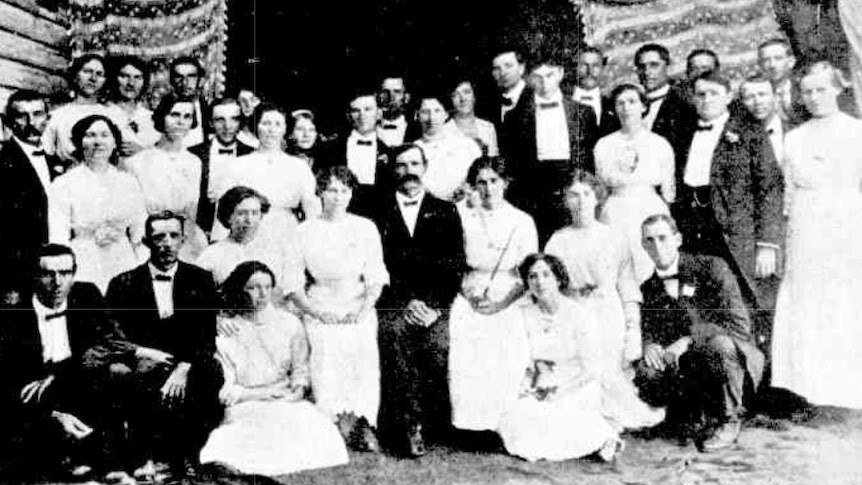
The Kurri Kurri choir who won the chief choral contest at the 1913 Taree eisteddfod (Photo  MidCoast Stories via the ABC)
Interesting piece by the ABC's Emma Siossian, Taree's first eisteddfod in 1913 was an impressive feat of logistics and planning.

As Heritage website  MidCoast Stories co-founder Penny Teerman noted, music festivals were popular in the early 20th century. In 1912, a limited but successful festival was held in Taree. This provided the impetus the following year for the formation of the Manning River Musical Festival Society - Penny calls it the Taree Musical Society but Trove searches suggest that it had a broader title  - to put on a larger event with multiple activities. This was a considerable success with multiple performers and a large number of spectators. 

The Leichhardt Boy's Choir performed in Taree during 1913..(Photo  MidCoast Stories via ABC)

I will leave you to read the story but wanted to make a few comments from my perspective as an historian of the broader New England. 

I was not sure about the use of the word eisteddfod. I think that the first named eisteddfod was put on in Ballarat in 1855 by Welsh miners attracted to the new gold fields, but widespread use of the name as opposed to musical festivals came later. I checked Trove, and the name eisteddfod was indeed used

Transport difficulties limited the scope of major events. On the North Coast where river transport was possible, events would draw along river routes. As the railways spread, they provided a means of drawing in a broader audience or group of participants. The 1913 Taree eisteddfod followed the opening of the railway. Participation still focused on surrounding areas but broader participation was possible, We can see this in 1913: participants came from regional areas linked by the railway but participation from the more distant Leichardt Boys Choir was also possible if more expensive

I noted the Kurri Kurri Choir. Music was an important form of shared entertainment on the coal fields. The number of attendees at band performances is a sign of just how popular local band music was.  

Wednesday, December 19, 2018

New England folk takes its place on the stage


International renown: Work done by Chris Sullivan and others in recording 19th Century New England music means the Tablelands has its own place on the UNESCO global folk music site. This is the fifth and last in this short series on the New England folk tradition

In my last column I spoke of the work of Chris Sullivan, Barry McDonald, Mark Rummery and others in recording and documenting the folk music tradition in New England and beyond.

One result of their work is that the New England Tablelands has its own small section in Folkways, the UNESCO site on global traditional music. However, that’s only part of New England’s often unrecognized role in the preservation and promotion of the Australian and New England folk traditions.

Our story begins with the local newspapers who not only published local stories, writing and sometimes song, but from the 1890s began to promote local history. This was followed by the formation of local historical societies beginning with Clarence River Historical Society in 1931.

With time, this led to the creation of local museums including the Armidale Folk Museum in 1958. This replaced the Armidale Museum, originally formed in 1933 as the first municipal museum in NSW.

Staff from the Teachers’ College and University played important roles in these development.

We have already discussed the role played by Russel Ward in the promotion of interest in Australia folk songs, including his influence on students.

Armidale Teachers’ College lecturer Eric Dunlop played a key role in the formation of the Armidale Folk Museum and in the broader museum movement. He believed in museums as an education tool and had developed a particular interest in folk museums while in Europe in 1953.

Ward and Dunlop were joined by others, including John Ryan. John played a significant role in the promotion of Australian folklore, editing the journal Australian Folklore from 1992. He also began the process of documenting folk traditions across the broader New England with a special focus on the literary tradition.

Meanwhile, the music continued. Both Gary Shearston and Mike McLellan became prominent national folk music performers, refreshing old songs and writing new ones. Their songs added to the specific New England tradition.

Shearston’s “Shopping on a Saturday” and “Tenterfield” paint evocative pictures drawn from his early life in Tenterfield, contrasting with the sadness of Peter Allen’s “Tenterfield Saddler.”

While Shearston’s songs draw from his Tenterfield childhood, Mike McLellan’s songs are influenced by his time at the Armidale Teachers’ College. “Saturday Night Dance” and “There is a Place” remain Armidale favourites.
Note to readers: This post appeared as a column in the Armidale Express Extra on 19 December 2018. I am repeating the columns here with a lag because they are not all on line outside subscription. You can see all the Belshaw World and History Revisited/History Matters columns by clicking here for 2009, here for 2010, here for 2011, here for 2012, here for 2013, here for 2014, here for 2015, here for 2016, here  2017here 2018 . 


Thursday, December 13, 2018

Reviving a musical tradition


Horton River Band 1967: Dave Game, Mark Rummery, Chris Sullivan, Lionel O'Keefe. The band became a major vehicle for presenting New England's folk tradition. This is the fourth in a series on the New England folk tradition

While the New England folk music tradition drew from European traditions, its expression was always local, especially in the rural areas which had to provide their own entertainment.

“I only saw the tail end of a long tradition Jim,” John Beswick recalled. This “centred around the Community Hall. A combination of dairy farming and Timber mills generated a dense rural settlement pattern outside local towns and regional centres and those communities worked hard by definition of their livelihoods but also enjoyed socialising when opportunity or design presented itself.”

John’s local halls were the Thora Hall at the foot of the Dorrigo Mountain on the Bellinger and the Turners Flat Hall on the Macleay. Different people, but exactly the same format.

“The music for the dancing was provided by locals with that ability, fuelled by byo grog, an always hot tea urn and a groaning table filled from the products of numerous busy kitchens. Our music was provided by a trio playing piano accordion, drum kit and fiddle. At some point when the dancers need a break, one or two of our number would give a song.”

This was a very self contained world, one in which those who were musically or lyrically inclined had a performance platform to practise and develop their talents. The result was local musicians such as the Kalang’s Bruce Pottie who wrote their own lyrics and made their own music but were only memorable in their local area.

By the 1970s, the combination of social, cultural and economic change had greatly diminished this local musical tradition. Many of the local musicians had died, those who remained who remembered the songs, dances and music of the past were rapidly aging.

Just as Russel Ward had played an important role in the folk revival of the early 1950s, now a group of Armidale based musicians sought to preserve and promote the music and songs of the past.

Chris Sullivan was a key figure in this process. He had been interested in folk music for an extended period, travelling Australia to collect music and songs.

Drawing from this and extending this experience, his Southern Cross University PhD thesis argued the case for an Australian folk music tradition.

In Armidale, Chris was joined by group including Barry McDonald, a former student of Russel Ward, Mark Rummery and Cathy Ovenden. Each collected, recorded and played folk music, documenting the folk tradition. 

The popular Horton River Band became a vehicle for them to play together and with some of the now old traditional performers. However, this is not the end of our story. 
Note to readers: This post appeared as a column in the Armidale Express Extra on 12 December 2018. I am repeating the columns here with a lag because they are not all on line outside subscription. You can see all the Belshaw World and History Revisited/History Matters columns by clicking here for 2009, here for 2010, here for 2011, here for 2012, here for 2013, here for 2014, here for 2015, here for 2016, here  2017here 2018 . 

Wednesday, November 28, 2018

Documenting a folk tradition


Cover of one edition of Russel Ward's The Australian Legend: Arguably the first major work on the Australian folk tradition since Banjo Paterson’s 1905 Old Bush Songs.This is the third in a series on the New England folk tradition

In 1956, the application of Australian historian Russel Ward for a lecturing position at the newly renamed University of NSW was rejected. He had been blackballed for his political beliefs, including his membership of the Communist Party.
"Ward had, UNSW Vice Chancellor J. P. Baxter told council, been 'active in seditious circles in Canberra'."
Ward had, UNSW Vice Chancellor J P Baxter told Council, been “active in seditious circles in Canberra”. The decision to not appoint Ward despite the unanimous recommendation of the selection committee created controversy.

Max Hartwell had been a member of the selection committee. Born at Red Range near Glen Innes where his father was school teacher, Hartwell had studied at the New England University College where he was a member of the first Rugby Union side in 1939.

Hartwell was now Professor of Economic History at UNSW. His political views were diametrically opposed to Ward’s Marxist world view, but he liked and respected Ward and was outraged by the decision. The result was a very public spat culminating in Hatwell’s resignation from UNSW and, subsequently, his move to Oxford.

In 1957, to Ward’s surprise, he received a telegram offering him a lectureship at the University of New England. He would spend the rest of his academic life at UNE.

Ward’s PhD thesis, his THING as he described it in his autobiography, was on “The Ethos and Influence of the Australian pastoral Worker”. In writing, Ward drew very heavily from Australian folk songs and ballads. He did not believe that they were in themselves accurate history, rather that they captured ethos and sprit.

Ward’s research drew him into the nascent folk revival that was taking place especially in Sydney with its musical, literary and political threads. Then, in 1958, Ward published the Australian Legend, arguably the first major work on the Australian folk tradition since Banjo Paterson’s 1905 Old Bush Songs.

The Australian Legend had a major impact and remains in print today. Among other things, it popularized the Australian folk tradition, if with a very particular focus.

Ward retained his interest in Australian folk music and folk traditions. However, changes were also taking place that would blunt both his influence and the Australian folk revival.

One change was the broader nature of the folk revival itself, including overseas influences such as Peter. Paul and Mary. A second change was the emergence of new popular musical forms including rock and roll, the Beatles and the rise of American influenced country music. There were shifts as well in the study of history itself as new topics and fashions emerged.

Russel’s influence did continue. We now come to a new stage in the story, one in which New England researchers and performers take centre stage. 
Note to readers: This post appeared as a column in the Armidale Express Extra on 20 November 2018. I am repeating the columns here with a lag because they are not all on line outside subscription. You can see all the Belshaw World and History Revisited/History Matters columns by clicking here for 2009, here for 2010, here for 2011, here for 2012, here for 2013, here for 2014, here for 2015, here for 2016, here  2017here 2018. 

Wednesday, November 21, 2018

Folk ballads hit the right spot


Read all about it: Sometimes racist and xenophobic, always nationalistic, the Bulletin magazine played a major role in promoting Australian bush ballads. This is the second in a new series on the New England folk tradition
Folk music is an integral part of the folk tradition.

Australia’s Aboriginal and Torres Strait Islander peoples had their music that was passed down through the generations. The European settlers brought their folk music with them, music that changed with circumstance and time. Later, these traditions would cross-pollinate.

Song, music and dance are all closely aligned. They feed each other.

The convicts brought the remembered songs from home, changing titles and words to suit their circumstances. Moreton Bay with its tale of convict suffering was fitted to the tune of the Irish song Boolavogue.

As European settlement spread, the convict tradition transformed into the bush ballads popular among itinerant agricultural workers. This was predominantly a male society.

Many worked alone in isolated locations, others traveled for work or came together for particular activities such as mustering. When they gathered together they told yarns or sang songs and sometimes danced around the camp fire, entertaining each other.

Many in this period were illiterate or semi-literate. Songs were learned by listening and practicing and then passed on in an evolving oral tradition.

Overseas influences could still be important. Botany Bay, one of Australia’s most famous folk songs with its opening line “Farewell to old England for ever”, is apparently based an a musical burlesque Little Jack Sheppard. This was staged at The Gaiety Theatre, London, in 1885 and then repeated in Melbourne the following year.

While overseas influences remained important, the bush ballad had become an Australian tradition with many local variants. This tradition reached its peak in the 1890s, partly driven by Sydney’s Bulletin magazine with its focus on Australia, Australian nationalism and Australian rural life.

Collapse followed as the spread of recordings, of cinema and radio, supplanted the previous oral tradition. Australian folk songs were replaced by US offerings.

By the 1930s, New England Country Party politician Mick Bruxner, a cousin of Australian film maker Charles Chauvel, was complaining bitterly about US cultural dominance in film and language.

Not all was lost, however. A new wave was about to emerge, one that would see something of a resurgence in Australian folk music including folk songs, a rediscovery in which New England would play an important part.

Next week I will tell you how and why. 
Note to readers: This post appeared as a column in the Armidale Express Extra on 13 November 2018. I am repeating the columns here with a lag because they are not all on line outside subscription. You can see all the Belshaw World and History Revisited/History Matters columns by clicking here for 2009, here for 2010, here for 2011, here for 2012, here for 2013, here for 2014, here for 2015, here for 2016, here  2017here  2018

Monday, November 12, 2018

The folk tradition in Australia's New England - a methodological note


New England folk group, The Horton River band, 1997. Dave Game, Mark Rummery, Chris Sullivan, Lionel O'Keefe. Photo: Bob Bolton

My current series of columns in the Armidale Express is a preliminary exploration of New England's folk traditions. I wandered into this area almost by accident. I had been picking up references to various elements in the folk tradition. Then while I was reading Russel Ward's autobiography, A Radical Life (Macmillan, South Melbourne 1988), I came across the story of champion clog dancer Harry Macklin Shaw. I knew of Russel's interest in Australian folk songs, he taught me, but had never heard of Shaw. My attention was caught, and I decided to try to pull together some material on folk traditions with a special focus on New England.

I did so with some caution. I am not especially musical, I am a very bad dancer and also knew enough to know that the area was something of a mine field. Still, I pushed ahead and now find that all my reservations had substance! Just understanding different forms of dance is itself itself a significant challenge.To help me, I decided to do a methodological note to supplement the columns.

The note itself is a work in progress, a placeholder for recording material, ideas and issues as I go along. So I will post some initial stuff now and then update it on a weekly basis as I go along. Later when I bring the necessarily short columns up on the blog, this post will provide supplementary information.

Coverage

My columns have a special but not exclusive focus on the Northern Tableands. However, my broader focus remains on the broader New England, the tablelands and the surrounding river valleys.

At this point, I am focusing on the post European settlement period,  The deep and extensive Aboriginal folk tradition is a different story, although there are later interlinks between the two.

Definition

As normally understood, the folk tradition is an oral and demonstration tradition, one in which knowledge and skills in things such as song, dance, music or children’s games pass directly from person to person. This simple definition includes a number of problems.

To begin with, who are the folk?  Wikipedia, for example, defines a folk museum as "a museum that deals with folk culture and heritage. Such museums cover local life in rural communities. A folk museum typically displays historical objects that were used as part of the people's everyday lives."  So rural and local, excluding urban communities. This narrow definition is reflected to some degree in the discussion on folk traditions where the folk are thought of in terms of working and especially rural people as compared to those in the middle and upper classes and especially those who live in metropolitan areas.    

However, Wikipedia also defines folklore in a way that is much broader:
Folklore is the expressive body of culture shared by a particular group of people; it encompasses the traditions common to that culture, subculture or group. These include oral traditions such as tales, proverbs and jokes. They include material culture, ranging from traditional building styles to handmade toys common to the group. Folklore also includes customary lore, the forms and rituals of celebrations such as Christmas and weddings, folk dances and initiation rites. Each one of these, either singly or in combination, is considered a folklore artifact. Just as essential as the form, folklore also encompasses the transmission of these artifacts from one region to another or from one generation to the next. Folklore is not something one can typically gain in a formal school curriculum or study in the fine arts. Instead, these traditions are passed along informally from one individual to another either through verbal instruction or demonstration.
This broader group based definition includes urban as well as rural groups. It allows for transmission between groups and between generations. It tries to specify the scope of folklore. However, it retains a focus on oral instruction or demonstration, where traditions are passed along informally. Here we come to another set of problems.

Non-literate societies use both formal and informal learning to pass on lore, knowledge and various forms of expression. We can see this in traditional Aboriginal societies where certain lore was passed on in a highly structured way through formal learning, while other skills and knowledge were acquired less formally. In the Celtic bardic tradition, bards were trained in a variety of skills to entertain and pass lore on. So in both cases, we actually have a mix of formal and informal learning.

The emphasis on oral instruction or demonstration raises different issues. Does a tradition cease to be a folk tradition if is is written down and passed on partially in that form? Some folk song purists have seemed to argue something close to that. They have also argued that new songs composed and then spread are not folk songs.

Neither position strikes me as especially sensible. Not only do transmission mechanisms vary, but I find it hard to think of Mike McClellan's Saturday Dance, his There is a Place or Gary Shearston's Shopping On A Saturday as other than New England folk songs. To my mind, the critical issues are neither source nor transmission but tradition, the extent to which folk traditions broadly defined are carried down through the generations.

to be continued