Discussions on the history and historiography of Australia's New England

Showing posts with label history. Show all posts

Tuesday, December 22, 2020

The remarkable story of the University of New England's Heritage Centre 4 - UNE only institution interested in preserving the records of the North

David Drummond in later years. Australian National Librarian Harold White wanted the Drummond papers to come to the National Library as a collection of national importance. To White's annoyance. Drummond insisted that they go to the University of New England Archives.

This is the fourth in a short series on the remarkable story of the University of New England's Heritage Centre and Regional Archives. 

Writing in the Australian Library Journal in March 1963, University of New England Archivist R J McDonald commented that the distinctive feature of the UNE case was the absence of any other intuitions interested in the records of the North.

If  "the University had not begun collecting records in this area they would not have been collected at all", McDonald wrote.

By now, the holdings had begun to expand rapidly, a process continued under the second archivist Alan Wilkes. Wilkes was determined to collect and preserve as many records as he could and would go to considerable lengths to do so, including collecting remote records by horse!

The 1960s marked the start of a period of great change.

Many smaller organizations such as dairy and banana cooperatives were closing. Long standing pastoral families who held records dating back to the foundation of the first runs were making hard choices about the retention or destruction of property and family records. Newspapers were deciding what to do with their records and past editions.

Under Wilkes’s vigorous collection policies these records started to flow to the UNE archives from across Northern NSW, a process aided by the loyalty felt by many to UNE and the North.

The transfer of the Drummond papers in the early 1960s is one example.

National Librarian Harold White, a good friend of David Drummond, had expected the collection to go to the National Library as a collection of national importance. He was not pleased when Drummond chose to pass them to the UNE Archives.

Drummond would not be budged. To his mind, the papers belonged with the University he had helped found.

The rapid rise in the collection saved many records that would have been lost, in so doing creating an archival collection of national importance. However, Alan’s vigorous approach also created a difficulty, the need to document the collection and to create finding aids that would allow easy access. This remains a problem today.

While the UNE archives were expanding, another move was taking place in a sister institution that would form the third important leg in the future New England Heritage Centre and Regional Archives.

From its foundation in 1928, the Armidale Teachers’ College focused on the practical craft of teaching as compared to the more academic approach followed at Sydney Teachers’ College.

One outcome was the work of Eric Dunlop on building museums including Armidale’s Folk and Education Museums, a second the creation of the Historical Resources Centre by Lionel Gilbert.

Now these moves would come together with the UNE Archives, creating the Heritage Centre and Regional Archives that we know today. 

Note to readers: This post was prepared as a column for the on-line edition of the Armidale Express. I am repeating the columns here with a lag because they are not all on line outside subscription. You can see all the Belshaw World and History Revisited/History Matters columns by clicking here for 2009, here for 2010, here for 2011, here for 2012, here for 2013, here for 2014, here for 2015,  here for 2016, here  2017here 2018, here 2019, here 2020 

Friday, December 11, 2020

The remarkable story of the University of New England's Heritage Centre 3 - creation of a professional archive


UNE Chancellor P A Wright with Honorary archivist, Vice-Admiral Sir Richard Lane-Poole. Sir Richard began the process of consolidating and documenting the growing regional archival collections, continuing the process of community involvement with UNE and what would become the UNE Heritage Centre. 

This is the third in a short series on the remarkable story of the University of New England's Heritage Centre and Regional Archives. 

The University of New England became autonomous in 1954. In that year, Robert Madgwick, now Vice Chancellor, issued a further call for the public to donate records to the University to support the University’s research plan.

 “This work”, Madgwick said, “can only be done with the sympathetic support and encouragement of the people of the region and I appeal to all those who have family papers and records of any sort to get in touch with the University.”

 The public responded, but Madgwick faced a problem. How should the new holdings be stored and accessed?

The University Library was still in Booloominbah where limited space and poor storage conditions were damaging book holdings. New facilities were needed, but cash was tight.

In May 1956, Frank Rogers, was appointed as Librarian, while work began on the construction of a temporary library on the east of the campus, later the Marshall Building.  

Rogers was a training archivist as well as librarian. In May 1957 space was allocated in the basement of the new building as a dedicated archives repository, while Rogers also recruited an able volunteer in retired Vice Admiral Sir Richard Lane-Poole to be the university archivist under Roger’s guidance.

Sir Richard proved an inspired choice because of his intelligence, energy and local connection, both building and helping document the collection.

In 1959 consideration began on what would become the NSW State Archives Act 1960, Madgwick and Rogers lobbied the Government asking that UNE be recognized in this legislation as a regional repository for the State Archives.

In the end, UNE was satisfied with Rogers being given a seat on the Board created under the Act to manage the state’s archives. The appointment recognized Roger’s specific skills, as well as UNE’s growing archival role.

 Rogers now appointed UNE’s first full time archivist, R J McDonald. In now familiar words, he directed McDonald in now familiar words to: 

Collect all research material likely to be of value in throwing light on the historical, economic and social development of Northern New South Wales from the earliest European settlement until recent times.

The focus on the period since European settlement reflects the times. The Centre’s relevance to Aboriginal history emerged later.

 The stage was now set for the next chapter in the story of the UNE Heritage Centre and Regional Archives, a period of significant expansion. 

Note to readers: This post was prepared as a column for the on-line edition of the Armidale Express. I am repeating the columns here with a lag because they are not all on line outside subscription. You can see all the Belshaw World and History Revisited/History Matters columns by clicking here for 2009, here for 2010, here for 2011, here for 2012, here for 2013, here for 2014, here for 2015,  here for 2016, here  2017here 2018, here 2019, here 2020 

Saturday, December 05, 2020

The remarkable story of the University of New England's Heritage Centre 2 - Cumpston and Madgwick combine to make official records available to regional students

Working in conjunction with History lecturer Mary Cumpston, Sir Robert Madgwick's actions in 1947 established the principle that official records could be held regionally to facilitate local access. This is the second in a short series on the remarkable story of the University of New England's Heritage Centre and Regional Archives. 

1947 marked a critical stage in the evolution of what we now know as the University of New England Heritage Centre and Regional Archives.

Ina Mary Cumpston, normally called Mary, had a problem, one that she was determined to solve.

Mary was an interesting woman, a pioneer in an academic environment still dominated by men.

Both her parents were community activists with a love of learning.

Her father, J H L Cumpston, was Commonwealth Director General of Health. His pioneering history of small pox in Australia (1918) is still a basic text. Her mother,

Mother Gladys Maeva Cumpston nee Walpole, was very interested in gardening, botany and native plants. Later, she would become actively involved in the braille movement.

 In 1936, Mary won a scholarship to study Arts at Sydney University. At university she was a member of the Sydney University ski team.

Upon completion of her studies, Mary came to the New England University College (NEUC) as a lecturer in history. There she found that historical records held in the Armidale Court House could not be accessed locally. Instead, the records would need to be transferred to the Mitchell Library in Sydney to allow access, requiring students and staff to travel to Sydney to see them.

This made no sense to Mary. She wrote to NEUC Warden Robert Madgwick in mid 1947seeking his support to try to fix the problem, 

Madgwick had arrived as Warden earlier that year, replacing Jim Belshaw who had been acting Warden as well as Head of History and Economics since Edgar Booth’s departure in 1945.

Madgwick would prove to be an inspired choice as Warden and later first Vice Chancellor. He was committed to the development of NEUC and saw adult education and community engagement as central to that development. He was also a capable negotiator.

Madgwick wrote to the Under Secretary of Justice of NSW complaining about lack of regional access. “This (the current position) was all very silly,” Madgwick told the Under Secretary. In July 1947, the Armidale Court Records were transferred to NEUC custody.

In that same month, Mary sailed for England to study at Oxford on a postgraduate scholarship and vanishes from our story. However, the episode had established the principle that regional archival records could be held locally for better access.

Note to readers: This post was prepared as a column for the on-line edition of the Armidale Express. I am repeating the columns here with a lag because they are not all on line outside subscription. You can see all the Belshaw World and History Revisited/History Matters columns by clicking here for 2009, here for 2010, here for 2011, here for 2012, here for 2013, here for 2014, here for 2015,  here for 2016, here  2017here 2018, here 2019, here 2020 


Saturday, November 28, 2020

The remarkable story of the University of New England's Heritage Centre 1 - beginnings

Dr J P Belshaw, October 1940. As head of history and economics at the newly established New England University College, Belshaw needed archival records for student use and to allow the College to fulfil its role in the promotion of economic, social and cultural development across Northern NSW. This is the first in a short series on the remarkable story of the University of New England's Heritage Centre and Regional Archives. 

Back in October 1919 I wrote on the economic, cultural and social benefits of family, local and regional history:

Achievement of these benefits depends upon a network of historical societies, family history groups, museums and archives spread across Northern NSW. Within that network, the University of New England’s Heritage Centre occupies a very particular place.

The Centre’s history is a remarkable one. I will share a little of that history with you over the next few columns

In 1938, the still small staff at the newly established New England University College faced considerable challenges. The College was founded to become the Sydney University of the North. It was expected to contribute to the economic, social and cultural development of the North. It was expected to provide a high quality university education to its new students.

 Staff took these responsibilities seriously, but lacked access to books and other resources necessary to support teaching, research and extension activities. An effort began to build local resources that students could use and that would also support research. This extended from history and economics into other disciplines including geology and geography.

 Initially progress was slow, but momentum did build. The first Master of Economic on New England’s history appeared in 1940, followed by Desmond Long’s BA Honours thesis, the History of New England 1832-1861.  With time, these theses in history and other disciplines would become a critical resource.

 Long went onto a Master’s thesis on the history of colonial New England, in so doing building up descriptions of source resources in various locations. He also wrote on the professional issues involved in the writing of regional history.

 In 1946, the Northern Daily Leader and other papers reporting on Long’s work carried an appeal for old records from any area of Northern NSW to be supplied to the History Department. The appeal noted that such records were often stacked away in homesteads, often brought out only to be destroyed.

In 1943, Jim Belshaw (Head History & Economics) and Alan Voisey (Head Geology & Geography) had attempted to establish a NEUC Research Bureau. This failed because of lack of money, but with the ending of the war, funding became available to fund a series of research monographs focused especially on the history of mining.

Writing in 1951 in the NEUC Regional Research Report, Belshaw described the area of geographic coverage as the Tablelands, North Coast, Upper Hunter and Western Slopes and Plains. This remains the formal coverage of the Heritage Centre today.

Belshaw also expressed the hope that, with time, the NEUC might be able to make some contribution to the welfare of Northern New South Wales. 

Note to readers: This post was prepared as a column for the on-line edition of the Armidale Express. I am repeating the columns here with a lag because they are not all on line outside subscription. You can see all the Belshaw World and History Revisited/History Matters columns by clicking here for 2009, here for 2010, here for 2011, here for 2012, here for 2013, here for 2014, here for 2015,  here for 2016, here  2017here 2018, here 2019, here 2020 

Monday, October 28, 2019

Maximising value from local and regional history - the case of mining history


Historical nugget: Jubilee Gold Mining Company, Rocky River, is part of our rich mining history, yet few outside the New England know of the scale of the mining province.This is third in a three part series on the economic, social and cultural value of family, local and regional history within the broader New England.
So far in this series, I have spoken of the growing interest in family, local and regional history. This comes partly from current locals, but far more from those outside the North who have lived there or have family connections to the area.

There are two further groups we need to consider.

The first is visitors who come to a particular location, often for a day or less to visit a particular attraction or just to see a place. This group drops into the local information centre, historical society or museum as part of their visit. They may have an interest in local history, but this is often peripheral to their visit. 

The second group covers those who have a particular interest from architecture to mining to Aboriginal history to bushrangers to Italian POWs. The range is quite enormous.

The first group is actually quite well catered too. The second is not.

Localism is the curse of the North. It is driven by locals who see their town as the centre of the universe, by councils who see their role as promoting and serving the areas covered by their shifting boundaries often in competition with other areas.

The term zero sum game is used to describe the situation where the pie is fixed, where one participant can only gain of someone else loses an equivalent amount. Tourism promotion and history’s role in tourism promotion is often treated as though it were a zero sun game.

This may sound extreme, but consider this case.

A week back, I had dinner with friends to meet his parents. They love mining and told me many fascinating stories about Lightning Ridge.

As part of their love of mining and of ghost towns, they regularly attend the Nundle gold/Chinese festival. They visit Glen Innes to fossick. But they had no idea that the western slopes of the Tablelands had once been the greatest tin province in the world.

They had no idea that Tingha had been a major mining center with a large Chinese population and its own China town. Driving through, they had noticed the Wing Hong Ling Museum, but it didn’t mean anything to them.

This struck me as a failure in information and promotion.

History is about stories. This is where we local and regional historians, amateur and professional, come in.

If we don’t get our mind above the local, if we don’t look for broader linkages and patterns, if we don’t tell a textured story, then those who depend upon us will be less effective.
Note to readers: This post appeared as a column in the Armidale Express Extra on 23 October 2019. I am repeating the columns here with a lag because they are not all on line outside subscription. You can see all the Belshaw World and History Revisited/History Matters columns by clicking here for 2009, here for 2010, here for 2011, here for 2012, here for 2013, here for 2014, here for 2015,  here for 2016, here  2017here 2018, here 2019    

Wednesday, October 23, 2019

Connecting to our past


Anniversary: Armidale Demonstration School (Armidale City Public) turns 150. Three alumni, Jim Belshaw, Rob Richardson and Paul Barratt. Paul was in the process of returning to the New England, I came much later, both drawn back by the sense of connection. This is the second in a three part series on the economic, social and cultural value of family, local and regional history within the broader New England.
In my first column in this brief series on the economic and cultural importance of history to Northern NSW, the broader New England, I spoke of the rise in interest in family and local history. This draws people to the various towns and localities across New England, re-establishing links and creating new opportunities.

The New England diaspora, those no longer living in the North but who were born here or have some form of family connection, now exceed the local resident population by more than three to one.

Not all these people are interested in family, local or regional history, but many are.
To give you one rough indication of scale, the Armidale Families’ Facebook page has well over 2,000 members who no longer live in Armidale but retain their connection.

Each year, there are hundreds of family reunions or centenaries or other special events that bring people back to the North. They all spend money, adding to local economic activity. To my mind, this is an underutilized resource.

In 2011, I found out almost by accident about the Armidale Demonstration School 150 year celebrations.

Older residents or ex-residents still call the school Armidale Dem. I do wonder why it was renamed when North Sydney still proudly uses the name demonstration.

You can understand why the school focused on current students and Armidale residents, but this ignored the rest of us (the majority) who live outside Armidale.

We started to organise. In the end, nine of us came back. It could have been many times that number if the celebrations had focused on the broader ex-student body, if support on things like bookings had been there.

I must emphasize that I am not being critical of the organizers. They did a wonderful job in bringing together so much memorabilia, in organizing an event to remember. But it was a missed opportunity.

So far, I have focused on family and local history with a special focus on locals or those with New England connections. But this is still only part of our story.

Across the North there are hundreds of museums and local historical societies that preserve and promote the culture and history of their localities.

Supported by councils and maintained by volunteers with a small number of paid staff, they form an integral part of our tourism infrastructure. They provide part of the experience that locals and visitors alike appreciate. They are a valuable asset.

And yet, despite council support and all the efforts of volunteers, we are not maximising the value they offer.  

In my last column in this short series I will explain why, suggesting what needs to be done to address the situation. 
Note to readers: This post appeared as a column in the Armidale Express Extra on 16 October 2019. I am repeating the columns here with a lag because they are not all on line outside subscription. You can see all the Belshaw World and History Revisited/History Matters columns by clicking here for 2009, here for 2010, here for 2011, here for 2012, here for 2013, here for 2014, here for 2015,  here for 2016, here  2017here 2018, here 2019    

Wednesday, October 16, 2019

Web of history revealed


Ancestry: West Armidale (now Drummond Memorial) Primary School 1960. Across the North there are probably a thousand history-related Facebook pages where people exchange stories and images such as this. This is the first in a three part series on the economic, social and cultural value of family, local and regional history within the broader New England. 
I will start this week’s column with a few blunt statements. History is worth money. I suspect too few people recognize this.

I also suspect that most people are not aware of the range of historical resources available across the broader New England that can enrich lives and also bring cash!
I suspect, too, that those who do recognize this tend to think of it in terms just of their attraction, accommodation or local area. This minimizes opportunities.

It would take a detailed economic study to start to quantify the value of history to the North. However, we can get something of a feel for it if we ask the question who is interested in the history of the North?

We can start here with the growing field of family history.

The disruption of Aboriginal life following European occupation led to many deaths. Then came forced relocations that merged different groups. Records of all this including births and deaths are scanty.

Not surprisingly, Aboriginal people now are seeking to trace their ancestry as best they can, to find out about the history not just of their families but the clans and language groups from which their ancestors came.

With 591 members, Armidale historian Caroline Chapman’s Facebook group, Discussion Group for Aboriginal History of New England, has become a major source of information and discussion for those seeking to find out about their ancestry in this area.

Callum Clayton Dixon’s Anaiwan Language Revival Program seeks to both revive the language and to document the story of the Anaiwan people. The Friends of Anaiwan Language Revival FB group has 130 members.

The settlers who came after British occupation, mainly British but including other groups such as Germans and Chinese, are just as interested in family history. This interest extends into local history, the stories of the areas in which their ancestors lived.

To give you an indication of scale, the Armidale Families past and present FB group has 3,116 members, the Uralla Memories FB group 2,245 members, Glen Innes and Surrounds Family History Memories 539 members and the Armidale Family History Group 340 members.

I have given you local FB examples because FB has become the main communication mechanism. I have only done a partial audit, the task is too big for a single individual, by my best guestimate is that across the North there are probably a thousand history related FB pages or groups, as well as blogs and web sites connected with localities, families, societies and museums. 

It is hard to estimate the total number of people involved but it must run into many tens of thousands.

These are not small numbers, but this is only part of the story of history in the North.
Note to readers: This post appeared as a column in the Armidale Express Extra on 9 October 2019. I am repeating the columns here with a lag because they are not all on line outside subscription. You can see all the Belshaw World and History Revisited/History Matters columns by clicking here for 2009, here for 2010, here for 2011, here for 2012, here for 2013, here for 2014, here for 2015,  here for 2016, here  2017here 2018, here 2019    


Thursday, June 21, 2018

UNE Humanities Weekly seminars on-line

In an earlier post, New England Travels: journeys through space and time, I posted a paper that I had delivered in the University of New England Humanities seminar series.

One of my frustrations in living away from Armidale is that I cannot get to the seminars on a regular basis. As you know my primary historical focus is on New England, but I'm always interested in what other people are doing and in other fields as well. It stops me becoming blinkered.

I mention this now because the University is making all the seminars available as podcasts including the discussion. The sound quality is a little variable, but not enough to be a significant problem. Four years of seminars are on-line, with seminars added generally the week after they have been delivered. You will find the full set here.

I am working my way through the whole series, starting with the ones in which I have the most immediate interest. You might like to have a browse.

Wednesday, January 03, 2018

The work of Dr Caitlin Green - the importance of the local effects of sea level changes on the detail of human history

The start of a new history year. May 2018 be a good year for all of us, personally and in research and writing. There is so much more to learn. At this point I haven't attempted any new year's resolutions. I may do so later. For the moment, I want to focus on one blog that I found over the break, Dr Caitlin Green's personal blog and website,. It's a blog I have really enjoyed.

Caitlin is an historian and writer whose professional interests lie in the history, archaeology, place-names and literature of late Roman and early medieval Britain. Don't let her field put you off. Even if you are not interested in her specific field, there is some good and fascinating stuff there that really spans.

Normally I would give you some examples to illustrate, a taste if you like. But this time, I want to follow through a series of linked posts over time that while in a different place are tangential to some of the discussion on this blog.

The Welton le Wold handaxes: 400,000 years ago

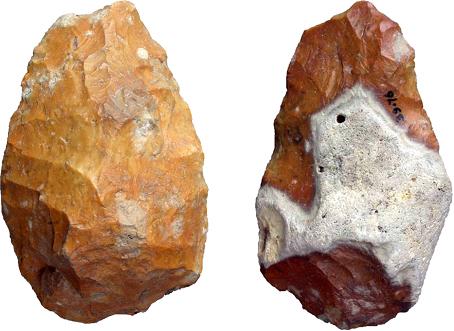
In The Welton le Wold handaxes & the earliest human activity in the Louth region (4 August 2014),  I had to look Louth up.  It's in Lincolnshire, an area that Caitlin has subjected to detailed study. The post discusses the latest dating evidence: "We therefore have, in the Welton handaxes, solid evidence that early humans were present in the Louth region around 400,000 years ago."
The Welton handaxes. Note the fine worked detail surviving after c400,000 years. 
The material in question comes from Welton le Wold quarry, which lies in the Lincolnshire Wolds around three miles to the west of Louth. They consist of three flint handaxes, a worked flake, and a number of fossil animal bones and teeth. Optically Stimulated Luminescence dating of the associated gravel suggests that the handaxes and fossil bones probably originated during a temperate period, the Hoxnian Interglacial, which lasted from around 424,000–374,000 years ago.

In her post, Caitlin discusses the life of the makers and their possible relationship to other English discoveries. In doing so, she outlines some of the huge climate and landscape changes that took place over the 400,000 years since and the way they might have affected both movement and evidence.

In Australia, we have become thinking in long terms as the date of human occupation of the continent has been progressively pushed back to now around 65,000 years. The time horizons in Europe and Africa are much longer because of the variety of Hominin species involved. One of the interesting questions is the possibility that we will find evidence of earlier hominin species in Australia. This seems more likely than it did a few years ago since the Hominin occupation of what is now Asia was far more widespread and complex than was once realised.

From Welton le Wold to the end of the last glacial period, c15,000 years ago 


This graph from Dr Caitlin Green provides a visual indication of temperature fluctuations over the last 800,000 years. Those fluctuations had huge impacts on human life.  
Caitlin continues the story in Of chalk and ice: the white cliffs of Louth in the Palaeolithic era  (24 September 2014). This traces the story from the handaxes probably used by pre- or ancestral Neanderthal hunters in the Hoxnian Interglacial around 400,000 years ago to the end of the last glacial period nearly 15,000 years ago.

The archaeological record is patchy, It appears that at 280,000 years ago there were at least occasional human visits, that around 57,000 years ago the as Neanderthal settlement and then around 35,000 years ago modern humans arrived.  The patterns reflect varying temperature patterns. The arrival of the Last Glacial Maximum effectively terminated much human settlement.

From 15,000 years ago

From 15,000 years ago, Caitlin's material is spread over multiple posts. I will list some of those posts in a moment, but I wanted to make some general comments first.

There is a constant battle between land and sea. The land extends itself through a process called progradation; rivers carry silt that can progressively build land through the formation of deltas. In New England, perhaps the most classic example is the lower Macleay valley where at the height of the Holocene the sea stretched inland to the site of modern Kempsey, only to be driven back to the current coastline through progradation.

For its part, the sea constantly erodes the land. Sometimes when there are big storms in combination with high tides, the sea can breach barriers reclaiming the land.

Sea level changes affect the whole process. Sea levels relative to land can change because sea levels rise. An extreme case is the rise in sea levels from 120 metres below current levels at the height of the Last Glacial Maximum to perhaps three metres above current levels at the peak of the warm Holocene period.

Sea levels relative to land can also change because the land itself rises or falls. Again, an extreme example is the shifts associated with the ending of the last ice age where the removal of the ice cap caused post glacial rebound. Land that had been forced down by the icecaps rose, causing land elsewhere to fall. Places that were ports, for example, find themselves inland. Places that were above water find themselves submerged. These are long term processes that continue today,

Post glacial changes are not the only factor at play, for continental shifts also affect land levels. Research suggests that as the Australian continent drifted north from Antarctica during the past 50 million years, it subsided by up to 300 metres and tilted to the north. Again, this is a long term process that continues today  It seems that the Australian continent is both moving north (1.5 metres in the last 22 years) and wriggling around as it moves.

One of the lessons all this, a lesson that Caitlin's posts with their focus on part of Lincolnshire illustrate, is that the local effects of these changes vary across the entire spectrum. You cannot simply apply generalised models without risk of error. You  actually have to analyse local conditions. This is true in general, but increases in importance as the time period under study increases.

Some of Caitlin's posts are:


Monday, September 04, 2017

Winners of the 2017 NSW Premier’s History Awards

On Friday night, 1 September, the 2017 NSW Premier’s History Awards were announced at the State Library of NSW as part of the official launch of NSW History Week.

Details of the winners are set out below. I have given links to the publishers plus the judge's comments for each award.

Australian History Prize ($15,000). From the Edge: Australia’s Lost Histories, Mark McKenna (Melbourne University Publishing) 

From the Edge contends that it is only when Australians look to the edge of their country that they can properly comprehend what makes their histories distinct. The book begins with an account of a walk along the southeast Australian coast in the late eighteenth
century, before moving on to the failed British attempt to establish a presence at Cobourg Peninsula, the search for profits at the Burrup Peninsula and James Cook’s stay at what is now Cooktown. The focus is on the encounter between Australia’s Indigenous and non‐
Indigenous inhabitants.

This evocatively written and innovative study is based on wide‐ranging research and fieldwork. It conveys a powerful sense of place. Attractive images are a vital component of the evidence it presents. A convincing case is made for the importance of historical connections between remote localities at opposite ends of the continent. By explaining why an understanding of these localities’ Indigenous stories is so essential, Mark McKenna makes a major contribution to the development of a more widely informed Australian historical consciousness.

From the Edge stands out in a competitive shortlist through the manner in which it highlights and makes sense of a complex network of local histories that deserve far greater attention than they have previously received. The book combines well‐told intriguing stories with sophisticated and clear analysis. McKenna demonstrates that Australians’ historical imagination can be enriched through a broader yet more geographically intimate view. He emphasises the significance of a local and regional perspective that emerges from the histories of locations that are ‘both on the edge of the continent and the edge of national consciousness’. Through detailed place studies that give special attention to Aboriginal–settler encounters, he offers a highly original contribution to understanding Australia’s past with considerable contemporary relevance.

General History Prize ($15,000). Japanese War Criminals: The Politics of Justice After the Second World War, Sandra Wilson, Robert Cribb, Beatrice Trefalt and Dean Aszkielowicz (Columbia University Press)

Japanese War Criminals showcases the power of collaboratively authored historical research. In its analysis of new sources written in multiple languages, it is truly transnational. It engages impressively with one of the most complex moral and legal problems — can we achieve justice and restitution for crimes committed during war?

Wilson, Cribb, Trefalt and Aszkielowicz have placed the war crimes tribunals in their full cultural, legal, diplomatic and political contexts. We read about the significance of the trials to people around the world as they struggled to return to ‘normal life’ and reconstitute moral order amid the wreckage produced by the war. The book skilfully shows that identifying criminal acts committed during militarised conflict is more than a matter of practical legal determination; it has implications that go well beyond setting parameters for just war and legal killing Japanese War Criminals is an exceptional book. It provides readers with fresh insights into the complex moral challenges, practical legal limitations and political constraints that influenced the Allied authorities in their execution of justice in the emotionally charged years following the Pacific War.

Never shying away from recognising the horror of crimes committed by the Japanese military, the book also reveals that the trials were complicated by the Allies’ efforts to prevent their own wartime atrocities from facing similar legal and moral attention. This powerful book shows us that the horror of war contaminates every aspect of civilised life, including the law and its ideals of justice and impartiality. It is a remarkable achievement, both for its intellectual reach and its deft handling of fraught ethical issues that continue to confront us today.

NSW Community and Regional History Prize ($15,000). Stories from the Sandstone: Quarantine Inscriptions from Australia’s Immigrant Past, Peter Hobbins, Ursula K. Frederick and Anne Clarke (Arbon Publishing)

The North Head Quarantine Station operated from the 1830s until it closed in 1984; it served as a holding station for passengers on inbound ships to New South Wales arriving from well‐known hotspots for contagious diseases. Stories from the Sandstone examines around 1600 engravings in many different languages that were carved into the rocks and walls around the Quarantine Station during its 150‐year history.

The book is beautifully illustrated with photographs of the engravings and paintings of the area. In addition to the inscriptions and graffiti, sources include official records, personal recollections, unpublished diaries, private correspondence, family trees and various archives. The authors draw from this rich body of sources to spotlight individuals who passed through the station and left their signatures in stone.  This fascinating and accomplished history of the Quarantine Station firmly locates the experiences of the local within the broader context of the global. It covers the history of immigration to Australia, the conditions of ship travel for men, women and children, the start of government public health measures and the establishment of official quarantine policies to manage arrivals and the spread of disease. It is a history contoured by how the governments of the day applied ideas of gender, race and culture to the treatment of diverse individuals. Such local experiences are set within the broader transnational framework of the history of trade, trade routes, theories of disease and pandemics.

Young People’s History Prize ($15,000). Maralinga’s Long Shadow: Yvonne’s Story, Christobel Mattingley (Allen and Unwin)

On 24 June 1952, the Aṉangu people were forcibly dislocated from the Ooldea Lutheran mission on their traditional land in South Australia and sent to Yalata, another mission station in the country of another Aboriginal people. The traditional Aṉangu country was renamed ‘Maralinga’ and handed over to British scientists to carry out nuclear tests which would contaminate the land for the next 24,000 years.

Maralinga’s Long Shadow tells the story of Aṉangu woman Yvonne (also known as Tjintjiwara), who experienced this dislocation. Her husband and two sons died of cancer when they were granted ‘salvage rights’ and sent to clean up Maralinga many years later.

This well‐researched and original history interweaves the account of nuclear testing at Maralinga with Yvonne’s biography, community service and career as an artist. It tracks her experience of life on mission stations, her grief at being tricked into allowing her baby to be removed from her care, her marriage and family life, her reunion with her adult son, and how the introduction of alcohol began to destroy the Yalata community.

Christobel Mattingley does an outstanding job handling the many strands of this complex narrative, telling the tale in a simple but powerful and accessible voice. The book is beautifully illustrated with photos from Yvonne’s life and vivid reproductions of her artwork. Despite the tragic history it recounts, Maralinga’s Long Shadow is suffused with hope because of Yvonne’s resilience and her determination to serve her community both in practical ways, and by passing on Aṉangu stories, traditions, and her art. This is an
important, moving and inspiring story.

Multimedia History Prize ($15,000). The Amboyna Conspiracy Trial, Adam Clulow (Roy Rosenzweig Center for History and New Media) 

In the 1620s, Dutch and English competition for control over the lucrative spice trade in the East Indies (present‐day Indonesia) reached a critical point. After uncovering an English plot to take the Dutch castle at Amboyna, the Dutch authorities tortured suspects, placed them on trial, and ultimately condemned to death 10 English merchants and 10 Japanese mercenaries. For the following decade, passions escalated as both sides clashed over the legitimacy of a trial that would become one of the most famous legal cases of its age.

The Amboyna Conspiracy Trial website invites us to revisit this seminal case. With a rich trove of digitised archival material, we become investigators, lawyers and jurors tasked with understanding historical events. The process is guided by insights from academic experts who explain the trial’s context within the spice trade and colonialism. Primarily designed for tertiary students, the interactive website is accessible to broader audiences. The Amboyna Conspiracy Trial asks us to investigate an event, on a human scale, that is dense with continuing issues of justice, journalism, politics and propaganda.

The Amboyna Conspiracy Trial website is an outstanding example of how maps, sketches, paintings and archival documents (in multiple languages) can be brought to life. It vividly and intelligently introduces us not only to the history surrounding the trial, but also to the tools of the historian in making sense of a trail of angry missives and public pamphlets. The Amboyna Conspiracy Trial is fresh, interesting and engaging. It is an important resource for teaching history and a model for multimedia history education.

Monday, June 19, 2017

New DNA results challenge Indian pre-conceptions


The thorniest, most fought-over question in Indian history is slowly but surely getting answered: did Indo-European language speakers, who called themselves Aryans, stream into India sometime around 2,000 BC – 1,500 BC when the Indus Valley civilisation came to an end, bringing with them Sanskrit and a distinctive set of cultural practices? Genetic research based on an avalanche of new DNA evidence is making scientists around the world converge on an unambiguous answer: yes, they did. Tony Joseph, Hindu Times
Interesting piece in the Hindu Times again illustrating the way that DNA analysis is re-shaping our view of the world.

I have absolutely no expertise in the question of Indo-Aryan migration, nor am I familiar enough with Indian politics to know how how questions of the direction of migration play out domestically. I had always assumed that part of the ethnic difference between the north and south of the country lay in the different migration patterns, with the north open to waves of migration from elsewhere in Eurasia. The latest data would appear to support that view.
Until recently, only data on mtDNA (or matrilineal DNA, transmitted only from mother to daughter) were available and that seemed to suggest there was little external infusion into the Indian gene pool over the last 12,500 years or so. New Y-DNA data has turned that conclusion upside down, with strong evidence of external infusion of genes into the Indian male lineage during the period in question.
Tony Joseph suggests that the reason for the difference in mtDNA and Y-DNA data is obvious in hindsight: there was strong sex bias in Bronze Age migrations. In other words, those who migrated were predominantly male and, therefore, those gene flows do not really show up in the mtDNA data. On the other hand, they do show up in the Y-DNA data:

In fact, about 17.5% of Indian male lineage has been found to belong to haplogroup R1a (haplogroups identify a single line of descent), which is today spread across Central Asia, Europe and South Asia. The Pontic-Caspian Steppe is seen as the region from where R1a spread both west and east, splitting into different sub-branches along the way. Genetic analysis suggests that the Indian versions of R1A split of between 2,000 and 1,500 BC.

Postscript 21 June 2017

Ramana, my Indian blogger friend, pointed me to this rebuttal of the Joseph piece, Genetics Might Be Settling The Aryan Migration Debate, But Not How Left-Liberals Believe. My first reaction was that  Anil Kumar Suri appeared to be wielding a rather hatchet in what was clearly an ideological dispute that I did not properly understand.

I need to go back to to the Joseph piece and look at the detail of DNA material provided to try to determine what is factual as compared to ideological positioning on both sides. Meantime, some one may be able to explain just what the apparent ideological and political dispute really is..

On a different topic, regular commenter Johnb has pointed me to yet another DNA study, First complete genome data extracted from ancient Egyptian mummies. For later reference.

Postscript 30 June 2017

Ramana  pointed me to another article on the same topic, Here We Go Again: Why They Are Wrong About The Aryan Migration Debate This Time. He also commented: "As you are probably aware, I am a student of Vedanta and as such have studied some of our old texts. The word Aryan is used in Sanskrit to describe people of noble character and not a race or tribe or caste.".

There is a whole Indian back story  in the controversy that I am simply not properly aware of.

Wednesday, June 01, 2016

The History Carnival 156

Welcome to the 156th edition of blogging's The History Carnival. I have has a significant computer crash, losing emails. If I miss anybody, please accept my apologies.

Drusilla Modjeska begins her book Stravinsky’s Lunch, a biography of Australian painters Stella Bowen and Grace Cossington Smith, with a story about Russian composer Igor Stravinsky. It appears that Stravinsky required total order and quiet when working, and it was his wife’s business to deliver this.

I mention this as an introduction to the first post in June’s History Carnival, Cath Feeley’s rather nice short piece on Misplaced Habits, Where are the women? Rewriting the history of Marx’s Capital. Floored by a question in her mock viva discussing her thesis on the British publication and reception of Karl Marx’s Capital about the absence of women in the story, Cath later investigated and found out that there were indeed women involved with the production of the book. It might well not have come out without them. I leave it to you to read the story.

Frog In A Well’s Alan Baumler’s Visual Digital History looks at the rise of internet recording including the digital archive and the implications for our craft. I was especially interested in the photos because of their Chinese content, interesting because I am interested in China, although it’s outside my primary field.

I think that we all wrestle a little with this one, the rise of the internet. It is just so convenient, but it does influence selection. For those of us who want people to be able to follow up our sources or who want to find things again, the constant loss of links and the shifting patterns of ever changing search algorithms also makes life hard.

In another post linked to history method, Dr Lucy Noakes MASS OBSERVATION AND THE CENTENARY OF THE FIRST WORLD WAR looks at current UK perceptions of the of the First World War. In a way, this is not history at all, these are current views, but the post links to history at several different levels.

If you know what views are at point in time, then you can ask how those views evolved. Some of the most valuable modern historical sources are anthropological and sociological studies of culture, attitudes and social structures. Then the post provides a perspective on the history and work of the Mass Observation organisation. I must admit to not having heard of it. However, its research carried out for other purposes now provides a valuable historical source.    

Architecture is part of physical and visual history, something that stands in the landscape that we can see.  Influenced by the availability of local materials, its also reflects the ideas and character of particular periods. Adrian Yekkes' Picture Post 54 - Stanhill Flats, Melbourne provides a fairly spectacular example of the Australian Art Deco style.  

While I always had an interest, I became really interested in Canadian history on a visit  a few years ago when I bought some histories and started reading.  To an Australian, there are obvious connections because of the two countries shared history and connection. However, excluding the Aboriginal people, Canadian history is both longer and more complex.

I was reminded of this by Anya Zilberstein's piece, Jamaican Maroons in Nova Scotia: The politics of climate and race. Canada's Caribbean connection continues to this day.  

On Friday 20 May,the remote Atlantic British Island of St Helena celebrated both  her new airport and her 514th discovery anniversary.

St Helena's long history includes her role as a British East India company base, although is the Island is best known now as Napoleon's place of exile. In a post, Napoléon à Sainte-Hélène: La conquête de la mémoire (6 April to 24 July 2016), on  Reflections on A Journey to St Helena, John Tyrrell reports on a joint exhibition by St Helena and the French Government on Napoleon's exile there.

John Hawks Weblog remains a good source on paleoanthropology, genetics and evolution. His Neandertal stone circles at Bruniquel Cave discuses the problems involved in using archaeological evidence to evaluate the past, especially the distant past.

Helen Webberley, a former host of the Carnival, has a nice eye for a good story, Her Robert Capa - Hungarian-American-world citizen photojournalist is a case in point. Perhaps he should have married Ingrid Bergman after all. She was clearly very keen and it might have kept him at home and alive! But then, perhaps not. He was a wanderer.

Mike Dash's Sorcerers and soulstealers: hair-cutting panics in old China traces the story of an outbreak of superstition in late Imperial China, setting it against the backdrop of Imperial power and structures. It's an interesting read.

At Musings, George Campbell Gosling wonders Am I a Contemporary Historian? I note that he is referring to his subject area, the history of medicine and charity in modern Britain, rather than his position in our craft. What is the dividing line between modern and contemporary history and does it matter anyway!

A remark by Vice-Chancellor of Queen’s University Belfast VC Patrick Johnston - Society doesn't need a 21-year-old who is a sixth century historian. - really got up the nose of Charles West. His Sorry, Vice-Chancellor. We need more historians of the sixth century was quite a stinging response. You will see where my sympathies lie!

That's all folks. The next edition of  the History Carnival will be at the many headed monster on 1 July. Usual nomination form.